

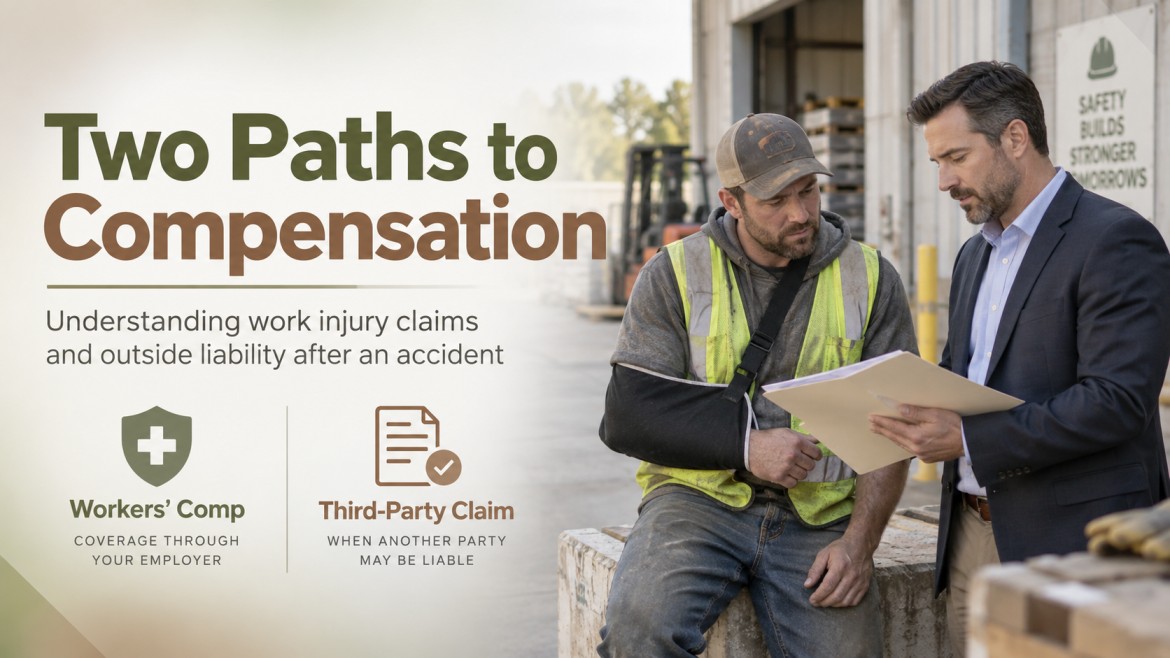
Third-Party Injury Claims can arise when someone other than your employer causes a workplace injury in Louisiana. Workers’ compensation is normally your only claim against your employer. But if someone outside your employment caused the accident, La. R.S. 23:1101 lets you bring a separate negligence claim against that person or company while your compensation benefits continue. A third-party claim can recover damages that compensation never pays, including pain and suffering. Whether you have one depends on who was at fault and whether that party is legally immune.
Key Takeaways
- Compensation pays regardless of fault, but it does not pay for pain and suffering, emotional distress, or loss of enjoyment of life. A third-party claim can.
- Both claims can proceed at the same time. R.S. 23:1101 preserves your right of action against a genuine third party, and compensation payments are not treated as a measure of your tort damages.
- Louisiana’s statutory employer rule (R.S. 23:1061) can make a principal or general contractor immune from suit even though it never employed you. Contract wording often decides the question.
- Your employer’s compensation payor is repaid out of a third-party recovery and receives a credit against future benefits. Settling without the required notice and written approval can forfeit your right to future compensation, including medical.
- The deadlines are different. Report the injury to your employer within 30 days, and the compensation claim generally prescribes in one year. Tort claims for injuries sustained on or after July 1, 2024 generally prescribe in two years.
If you were hurt on the job in Louisiana and someone other than your employer caused it, you are dealing with two claims at once, governed by two different bodies of law, with two different sets of deadlines. Handling one well and the other badly is a common and expensive mistake.
This article explains how the two claims fit together under Louisiana law, what each one can and cannot recover, the statutory employer rule that quietly ends many third-party claims before they start, and how your employer’s insurer gets paid back. It cannot tell you whether you personally have a claim. That depends on facts, contracts, and evidence specific to your accident.
What Happens When Someone Other Than Your Employer Causes a Work Injury
Most Louisiana work injuries begin and end inside the workers’ compensation system. That system is a trade. You give up the right to sue your employer, and in exchange you receive benefits without proving anyone did anything wrong. La. R.S. 23:1032 makes compensation your exclusive remedy against your employer, its principals, and its officers, directors, and co-employees, with a narrow exception for intentional acts.
That trade only covers your employer and the people the statute protects. It does not shield an outside driver, an equipment manufacturer, a property owner, or another contractor’s crew.
What Workers’ Compensation Covers in Louisiana
Louisiana compensation benefits generally fall into three groups:
- Medical treatment for the work injury, subject to the system’s fee schedule, approval rules, and utilization review.
- Wage benefits calculated from your average weekly wage under a statutory formula, subject to statutory caps. These include temporary total disability, supplemental earnings benefits, and permanent partial disability.
- Death benefits for surviving dependents.
What compensation does not pay is just as important. There is no recovery under the compensation system for pain and suffering, emotional distress, loss of enjoyment of life, or a spouse’s loss of consortium. Those categories were never part of the bargain. For a worker with a serious or permanent injury, these can be the largest part of what the injury actually cost.
Fault is largely irrelevant on the compensation side. Ordinary carelessness on your part does not defeat benefits.
What a Third-Party Injury Claim Is
A third-party injury claim is an ordinary Louisiana negligence case brought under La. C.C. art. 2315 against someone outside the protected employment relationship. It is filed in district court, not before a workers’ compensation judge, and it is resolved through insurance negotiation, settlement, or civil litigation.
The statute defines the term broadly. Under R.S. 23:1101(C), a “third person” includes any party who injures you at the time of your employment, and also a party who injures you later if that later injury aggravates the work-related injury and keeps your employer on the hook for benefits.
The trade-off is the burden of proof. You must show the third party was at fault and that the fault caused your harm. In exchange, the full range of Louisiana tort damages becomes available.
Why the Two Claims Exist Side by Side
R.S. 23:1101(A) is explicit. Claiming or receiving compensation does not affect your right of action against a third person, and the compensation paid is not a measure of your damages in that case.
The reasoning is straightforward. The compensation bargain was struck between employers and employees. An outside company that dropped a load of pipe on you was never part of that bargain and does not get the benefit of it.
Workers’ Compensation vs. Third-Party Injury Claims: The Key Differences
The two claims differ on almost every point that matters to an injured worker.
| Issue | Workers’ Compensation | Third-Party Injury Claim |
|---|---|---|
| Who you file against | Your employer’s workers’ compensation insurer | The outside person or company whose negligence caused your injury |
| Do you have to prove fault | No. Benefits are available regardless of who caused the accident | Yes. You must prove the third party was negligent and that the negligence caused your injury |
| Medical treatment | Covered under the workers’ compensation system, subject to its rules and approvals | Recovered as damages, including the cost of future treatment you will still need |
| Wage loss | Partial wage replacement calculated under the workers’ compensation formula | Full lost income, plus reduced future earning capacity if the injury limits your work |
| Pain and suffering | Not recoverable | Recoverable |
| Emotional distress | Not recoverable | Recoverable |
| Loss of enjoyment of life | Not recoverable | Recoverable |
| Loss of consortium for your spouse or family | Not recoverable | Recoverable |
| Effect of your own fault | Generally does not bar benefits | Your recovery is reduced by your percentage of fault |
| How the claim is resolved | Through the Louisiana workers’ compensation system | Through insurance negotiation, settlement, or a civil lawsuit |
Two rows need a Louisiana-specific caveat. On medical expenses, R.S. 9:2800.27(D) limits what you can recover in the civil case for treatment that workers’ compensation paid: recovery of those medical expenses is capped at the amount paid under the compensation medical payment fee schedule, not the amount billed. Future medical care that you can prove you will still need is a separate item and is not limited that way. On the effect of your own fault, Louisiana changed its rule on January 1, 2026, and the comparative fault section below explains what that means for you.
When a Workplace Injury Creates a Third-Party Claim
A third-party claim exists when someone outside your employment owed you a duty of reasonable care and breached it. Certain fact patterns come up repeatedly on Louisiana job sites.
| Situation | Who May Be Liable | Common Examples |
|---|---|---|
| A motor vehicle crash while working | The at-fault driver and their insurer, and possibly that driver’s employer | Being rear-ended while driving between job sites or making a delivery |
| Another company’s crew on the same site | That company and its employees | A subcontractor’s worker drops material or operates equipment carelessly |
| Defective equipment or machinery | The manufacturer, distributor, or the company that supplied the equipment | A machine guard fails, a tool malfunctions, or a lift gives way |
| Unsafe conditions on someone else’s property | The property owner or the business controlling the premises | Falling on an unmarked hazard while making a delivery to a client site |
| Improper maintenance or repair by an outside company | The maintenance or repair contractor | A serviced vehicle or machine fails because of faulty repair work |
| Negligence by a vendor, hauler, or outside service provider | That vendor or service company | A delivery driver strikes a worker while unloading at your job site |
The list is not exhaustive, and appearing on it does not mean a claim exists. Multi-employer sites in the Acadiana region, particularly industrial, energy service, and construction work, frequently involve several companies on one job. That is exactly where third-party claims are found, and also where the statutory employer defense discussed next is raised most often.
The Statutory Employer Rule That Can Block a Louisiana Third-Party Claim
This is the rule most likely to surprise an injured Louisiana worker, and the one most often missing from general articles about suing a third party.
What the Statutory Employer Doctrine Means
Under R.S. 23:1061(A)(1), a “principal” that contracts out work forming part of its own trade, business, or occupation becomes the statutory employer of the contractor’s employees. It owes compensation benefits to those workers, and in return it receives the exclusive remedy protection of R.S. 23:1032.
The statute supplies the test. Work is part of the principal’s trade, business, or occupation if it is an integral part of, or essential to, that principal’s ability to generate its own goods, products, or services.
In plain terms: a company you never worked for can end up with the same immunity your own employer has.
Why a Contractor You Do Not Work For May Still Be Immune
Louisiana also recognizes what practitioners call the two-contract situation. R.S. 23:1061(A)(2) provides that a statutory employer relationship exists whenever the work your immediate employer provides is contemplated by or included in a contract between the principal and some entity other than your employer.
Hypothetical example: a plant owner hires a general contractor to build a new unit. The general contractor subcontracts the scaffolding to your employer. You are injured by the general contractor’s crew. Because your employer’s scaffolding work is included in the contract between the general contractor and the plant owner, the general contractor may qualify as your statutory employer even though it never hired you. Whether it does depends on the actual contracts and the actual work.
How Contract Language Affects Whether Immunity Applies
Outside two-contract situations, R.S. 23:1061(A)(3) sets a written-contract requirement. No statutory employer relationship exists between a principal and a contractor’s employees unless there is a written contract between the principal and the contractor, being your immediate employer or your statutory employer, that recognizes the principal as a statutory employer.
When such a clause exists, the statute creates a rebuttable presumption that the relationship exists, and that presumption can be overcome only by showing that the work is not an integral part of or essential to the principal’s ability to generate its goods, products, or services.
That is a narrow door. It also means the outcome may turn on paperwork you have never seen. Master service agreements, purchase orders, and subcontracts held by other companies frequently decide whether the case is a lawsuit or a compensation claim only.
Why This Question Must Be Answered Before You File
Three practical reasons. First, it determines who is a defendant and who is not. Second, the filing deadline keeps running while the question is being sorted out, and contracts held by other parties take time to obtain. Third, immunity does not remove that company from the case entirely.
La. C.C. art. 2323(A)(1) requires the fault of all persons who caused or contributed to the injury to be allocated, including persons who are immune by statute, expressly naming R.S. 23:1032. Article 2324(B) then makes each responsible party liable only for its own share. So a percentage of fault assigned to an immune statutory employer is a percentage that no one pays you.
Can You Receive Workers’ Compensation and File a Third-Party Claim?
Yes, in the ordinary case. The important detail is how the money is divided at the end.
How Louisiana Allows Both Claims at the Same Time
R.S. 23:1101(A) preserves the tort action expressly. You may claim compensation and separately proceed against the third person, and the compensation you received does not reduce or define what the third party owes. In practice, both tracks run in parallel: treatment and indemnity benefits through the compensation system, and the liability claim through the third party’s insurer or the courts.
How Your Employer’s Insurer Gets Reimbursed From Your Settlement
The compensation payor has its own statutory recovery rights, and they come first. Under R.S. 23:1103(A)(1), when damages are recovered in a suit against a third person, they are apportioned so that the employer’s claim for compensation actually paid takes precedence over the injured employee’s claim. If the recovery is only enough to reimburse the employer, it is assessed solely in the employer’s favor, and only the excess goes to you.
That reimbursement is not a fixed number floating free of the case. Under R.S. 23:1101(B), the employer’s recovery is identical in percentage to yours, and where your recovery is reduced by comparative negligence, the employer’s recovery is reduced by the same percentage.
What a Credit Against Future Benefits Means for You
Repayment of past benefits is only half of it. The compensation payor also receives a credit against benefits it would otherwise owe going forward, which means it may lawfully stop paying until that credit is exhausted.
Under R.S. 23:1102(B), when you compromise with the third party, the employer or insurer owes future benefits only after receiving a dollar-for-dollar credit against the full amount paid in compromise, less the attorney fees and costs you paid in prosecuting the third-party claim. R.S. 23:1103(A)(1) likewise reduces the credit against future compensation by the attorney fees and court costs you paid in the third-party suit.
The practical effect is easy to miss: a settlement can put money in your hands now and simultaneously suspend your medical and wage benefits for a long stretch afterward. If you are still treating, that trade needs to be modeled before you agree to anything.
Notice and Intervention Requirements You Cannot Ignore
R.S. 23:1102(A)(1) requires whichever side files suit against the third person to notify the other in writing, forthwith, including the name of the court where the suit was filed. The other side may then intervene as a party plaintiff. In most third-party workplace cases, the compensation insurer does intervene.
The penalty for getting this wrong is severe. Under R.S. 23:1102(B), if you fail to notify the employer or insurer of the suit, or fail to obtain written approval of a compromise from the employer and insurer at or before the compromise, you forfeit the right to future compensation, including medical expenses.
The statute provides a partial safety valve. Future compensation above the compromise amount can still be reserved if the employer or insurer is paid the total of compensation and medical benefits previously paid, exclusive of attorney fees arising out of the compromise, with that payment capped at fifty percent of the total recovered, and only after the dollar-for-dollar credit is applied. Note also that written approval must come from the employer itself where the employer is self-insured in whole or in part.
Why Settling a Third-Party Claim Without Coordinating Both Is Risky
Adjusters on the liability side have no obligation to protect your compensation benefits, and a settlement offer will not come with a calculation of what it costs you in future benefits or reimbursement.
Before a third-party settlement makes sense, four numbers have to be on the table at once: what has already been paid in benefits and must be reimbursed, what future benefits the credit will suspend, what your fees and costs are, since they reduce the credit, and what is realistically left. Signing a release without those numbers can convert a reasonable-looking offer into a net loss.
How to Prove a Third-Party Workplace Injury Claim
The compensation system is administrative and forgiving on fault. The third-party claim is a civil case, and the burden of proof sits with you.
Establishing the Third Party’s Duty of Care
Louisiana negligence claims rest on La. C.C. arts. 2315 and 2316, which oblige a person to repair damage caused by their own fault or want of skill. Courts analyze whether the defendant owed a duty, whether it was breached, and whether the duty extended to protecting against the particular risk that harmed you.
Depending on the facts, other bases of liability may apply instead of or alongside ordinary negligence:
- Custodial liability under art. 2317.1, where an owner or custodian is answerable for damage from a defect it knew or should have known about and failed to remedy with reasonable care.
- Building owner liability under art. 2322 for damage caused by ruin, vice, or defect.
- Vicarious liability under art. 2320, which makes an employer answerable for its own employee’s negligence in the course and scope of employment.
- Product claims against a manufacturer, which in Louisiana proceed under the Louisiana Products Liability Act, R.S. 9:2800.51 et seq., and are limited to the theories that Act allows.
Proving Negligence or Another Basis for Liability
Proof usually comes from the ordinary record of the job site rather than from expert opinion alone. Safety plans, job safety analyses, equipment inspection and maintenance logs, training records, contracts allocating responsibility for a task, and incident reports prepared by other companies all tend to show who was supposed to do what.
Written standards matter too. Manufacturer manuals, industry practice, and site safety rules can supply the benchmark against which a company’s conduct is measured.
Establishing That the Negligence Caused Your Injury
Causation has two parts. You must show the conduct was a cause in fact of the harm, and that the harm falls within the scope of the duty breached. Defendants attack this element more often than they attack the underlying carelessness.
Two issues recur. Pre-existing conditions are not a bar in Louisiana, since aggravation of an existing condition is compensable, but the medical records must distinguish the new injury from the old one. Gaps in treatment also invite an argument that something else caused the current complaints, so consistency in treatment matters to the case as well as to your health.
Documenting the Full Extent of Your Damages
Damages in the civil claim are broader than compensation benefits and require separate proof. Economic damages include past medical expenses, subject to the fee-schedule limit discussed above where compensation paid them, future medical care, full lost earnings rather than the statutory percentage, and reduced earning capacity where the injury limits what you can do.
General damages cover pain and suffering, mental anguish, disability, disfigurement, and loss of enjoyment of life. A claim for loss of consortium belongs to your spouse or child, not to you, and is asserted alongside your claim.
Evidence That Strengthens a Third-Party Claim
- Photographs and video of the scene, equipment, and hazard before anything is repaired or removed.
- The names of every company present, not just the individuals, since identifying the employer determines who can be sued.
- The defective part, tool, or component itself, preserved rather than returned or discarded.
- Site sign-in sheets, badge records, and delivery paperwork confirming who was there.
- Witness names and personal contact information, since coworkers and contractors move between jobs.
- Consistent medical documentation from the first visit forward, describing how the injury happened.
How Comparative Fault Affects Your Recovery
Louisiana’s Comparative Fault Rule and the 2026 Change
Louisiana was a pure comparative fault state for more than four decades. That changed. Act 15 of the 2025 Regular Session amended La. C.C. art. 2323, effective January 1, 2026, to adopt a modified system: a person whose share of negligence is equal to or greater than fifty-one percent recovers nothing, and a person below that threshold has damages reduced in proportion to their own percentage.
Which rule applies depends on when the incident happened. Accidents arising before January 1, 2026 remain under the former pure comparative fault rule, under which a majority-at-fault plaintiff could still recover a reduced amount. Because the tort filing period is now two years, both regimes are live at the moment, and older injuries are not governed by the new bar.
How Your Own Percentage of Fault Reduces What You Receive
Below the bar, the arithmetic is simple. If proven damages are valued at a given figure and you are assigned twenty percent of the fault, you recover eighty percent of that figure. At forty percent fault, you recover sixty percent. At fifty-one percent, under the current rule, you recover nothing from the third party.
Your compensation benefits work differently. Ordinary carelessness on your part generally does not defeat compensation, so a fault finding hits the civil claim without erasing the benefits side.
How Fault Is Divided Among Multiple Responsible Parties
Louisiana does not make co-defendants cover each other. Under La. C.C. art. 2324(B), liability for damage caused by two or more persons is a joint and divisible obligation, and a joint tortfeasor is not liable for more than its own degree of fault and is not solidarily liable for damages attributable to another person’s fault.
That has a real consequence on a multi-company job site. If one responsible company is uninsured, insolvent, or never identified, its share is not absorbed by the others. Identifying every responsible party early is therefore part of protecting the value of the claim, not a formality.
One point cuts in your favor. Article 2324(C) provides that interruption of prescription against one joint tortfeasor is effective against all joint tortfeasors.
Why Your Employer’s Fault Can Still Matter to Your Claim
Your employer cannot be sued in tort in the ordinary case, but its conduct is still on the verdict form. Article 2323(A)(1) requires fault to be allocated to all persons who caused or contributed to the injury regardless of immunity by statute, naming R.S. 23:1032 specifically, and Article 2324(B) repeats the point.
Expect the third party to argue that your employer’s supervision, training, or work methods caused the accident. Any percentage placed there reduces what the paying defendants owe. It also reduces the compensation insurer’s reimbursement, since R.S. 23:1101(B) cuts its recovery by the same percentage as yours.
Defenses a Third Party Will Raise Against You
Knowing the standard defenses helps you understand why certain evidence is requested early.
Disputing Negligence and Liability
The first response is usually that the third party did nothing wrong, or that the condition was open, obvious, and part of the ordinary hazards of the job. Statutory employer immunity is also raised at this stage, sometimes by motion before any discovery into the merits.
Disputing Causation
A defendant may concede a mistake but argue it did not cause your injury. Common versions include an alternative mechanism of injury, a degenerative condition visible on imaging, or an unrelated event between the accident and the treatment.
Shifting Fault Onto You or Your Employer
Because Louisiana allocates fault to everyone, including immune parties, defendants have a direct financial incentive to spread blame. Expect arguments about your training, your use of protective equipment, whether you followed a procedure, and whether your employer should have controlled the area.
Challenging the Severity of Your Injuries
Independent medical examinations, review of prior records, and surveillance are routine in serious cases. Inconsistencies between what you report and what your records or activity show are the usual target.
Disputing the Amount of Your Damages
Even with liability resolved, the value of future medical care, the extent of lost earning capacity, and the reasonableness of billed charges are all contested. The fee-schedule limit on compensation-paid medical expenses under R.S. 9:2800.27(D) is part of that discussion.
What to Do After a Workplace Accident Involving a Third Party
Report the Accident to Your Employer Immediately
Reporting protects the compensation claim and creates the first contemporaneous record of how the injury happened. R.S. 23:1301 requires notice of the injury to your employer within thirty days. Report it in writing where you can, and keep a copy.
Seek Medical Treatment and Follow Through
Tell the provider how the injury occurred, including any equipment or other company involved. That history becomes evidence in both claims. Attend follow-up appointments; gaps are used against you later.
Identify Every Company and Person Present at the Scene
This step matters more in third-party cases than in any other kind. A name without an employer is often a dead end. Record company names on trucks, uniforms, badges, and equipment.
Preserve Photos, Video, and Physical Evidence
Job sites are repaired quickly, and site camera footage is frequently overwritten within days or weeks. Photograph the scene and the equipment before anything is moved, and do not return a defective part until someone has advised you on preserving it.
Collect Witness and Insurance Information
Get personal contact information for witnesses rather than only a work number, since contractors move between jobs. Note any insurance information exchanged, particularly in vehicle collisions.
Avoid Statements That Could Harm Either Claim
A third party’s adjuster may seek a recorded statement early. You are generally not required to give one to another party’s insurer, and casual guesses about speed, distance, or fault are difficult to walk back. Report the facts to your employer, tell your doctors the truth, and get advice before giving a recorded statement or signing a release or medical authorization.
Deadlines That Apply to Both Claims
The two claims run on separate clocks. Meeting one deadline says nothing about the other.
Why Workers’ Compensation Reporting Deadlines Run Separately
Notice of the injury must be given to your employer within thirty days of the injury or death under R.S. 23:1301. Where the employer failed to keep the required notice posted, R.S. 23:1305(B) extends that period to twelve months.
The compensation claim itself is governed by R.S. 23:1209. In general, claims are barred unless within one year of the accident the parties have agreed on payments or a formal claim has been filed. Where payments have been made, the period generally runs one year from the last payment, extended to three years in certain supplemental earnings benefit situations. Where the injury does not develop immediately, the period generally runs from when the injury develops, subject to the outer limits in the statute.
How Louisiana Prescription Applies to the Third-Party Claim
Louisiana calls its filing deadline prescription. For delictual actions, La. C.C. art. 3493.1 provides a two-year prescriptive period running from the day the injury or damage is sustained. That article came from Act 423 of 2024, took effect July 1, 2024, and applies prospectively. Injuries sustained before that effective date remain governed by the former one-year period.
Exceptions and variations exist. Claims against public entities, product claims involving minors with permanent disability, and situations involving interruption or suspension of prescription can all change the analysis. A general rule is not a calculation of your deadline.
Why a Missed Deadline on One Claim Can Affect the Other
The claims are financially connected. If the third-party claim prescribes, the compensation payor loses the recovery it expected, and you lose the only source of pain and suffering damages while the reimbursement and credit rules no longer help you at all. In the other direction, a compensation claim that is never properly pursued can leave you paying for treatment out of pocket while the civil case is still years from resolution.
Why Both Claims Should Be Evaluated at the Same Time
Practical reasons dominate here. Contracts that decide the statutory employer question take time to obtain. Site video is overwritten. Companies that were on site reorganize or dissolve. And no informed decision about a third-party settlement can be made without knowing the reimbursement and credit exposure on the compensation side.
When to Contact a Lafayette Personal Injury Attorney
Not every work injury needs a lawyer. These situations usually justify at least one conversation.
When Someone Other Than Your Employer May Be Responsible
If an outside driver, vendor, property owner, repair company, or equipment manufacturer had a role in the accident, the possibility of a second claim exists and should be evaluated before the filing period runs.
When Multiple Companies Were Working at the Same Site
Multi-employer sites raise the statutory employer question immediately, and answering it usually requires contracts held by parties who have no obligation to hand them to you.
When Your Employer’s Insurer Claims Reimbursement or a Credit
Once an intervention is filed or a credit is asserted, the division of any recovery is being decided. The notice and written-approval rules in R.S. 23:1102 apply from that point forward, and the consequences of getting them wrong fall on you.
When Liability or Fault Is Disputed
With the fifty-one percent bar now in place for accidents on or after January 1, 2026, a disputed fault percentage is no longer only a discount. It can decide whether there is any civil recovery at all.
When Your Injuries Are Serious or Permanent
The larger the future medical care and lost earning capacity, the wider the gap between what compensation pays and what the injury actually costs. That gap is what a third-party claim exists to address. You can read more about how the firm handles these matters on the Sorkow Law personal injury practice page.
Frequently Asked Questions About Third-Party Workplace Injury Claims
Can I sue someone if I already receive workers’ compensation in Louisiana?
Generally yes, if the person or company you want to sue is outside the protected employment relationship. R.S. 23:1101(A) preserves your right of action against a third person, and receiving benefits does not reduce what that third party owes. Your employer’s payor will have reimbursement and credit rights against what you recover.
What can a third-party claim recover that workers’ compensation cannot?
Pain and suffering, emotional distress, loss of enjoyment of life, and a spouse’s loss of consortium. It can also recover full lost earnings and reduced earning capacity rather than the partial wage replacement the compensation formula allows.
Can I sue my employer for a workplace injury in Louisiana?
Usually not. R.S. 23:1032 makes compensation the exclusive remedy against your employer, its principals, and its officers, directors, and co-employees, with a narrow exception for intentional acts. That exception is interpreted strictly and rarely applies to accidents caused by carelessness, however serious.
Does my employer’s insurance company get part of my settlement?
Yes, in most cases. R.S. 23:1103(A)(1) gives the employer’s claim for compensation actually paid precedence over your claim out of the recovery, and R.S. 23:1102(B) gives a dollar-for-dollar credit against future benefits, reduced by the attorney fees and costs you paid to pursue the third-party claim. The reimbursement is also cut by the same comparative fault percentage that reduces your own recovery.
What if I was partly at fault for the accident?
For accidents on or after January 1, 2026, La. C.C. art. 2323 bars recovery entirely if your share of negligence is fifty-one percent or more, and reduces recovery proportionally below that. Accidents before that date fall under the former pure comparative fault rule. Your compensation benefits are generally not defeated by ordinary carelessness either way.
How long do I have to file a third-party injury claim in Louisiana?
For injuries sustained on or after July 1, 2024, La. C.C. art. 3493.1 generally allows two years from the day the injury is sustained. Injuries before that date fall under the former one-year period. Different rules can apply to claims against public entities and in other situations, so the general rule should not be treated as your personal deadline.
What is a statutory employer in Louisiana?
A principal that contracts out work forming an integral or essential part of its own business, and therefore stands in the position of your employer under R.S. 23:1061. A statutory employer owes compensation benefits and receives immunity from tort suit. Outside two-contract situations, the relationship generally requires a written contract recognizing the principal as a statutory employer, which then creates a rebuttable presumption.
Talk to a Lafayette Attorney About Your Workplace Injury Claim
A workplace injury caused by another company is two claims, not one, and the decisions that matter most tend to arrive early: who was responsible, whether a statutory employer defense applies, what your employer’s insurer will claim back, and which filing period governs. Those questions are far easier to answer while the evidence still exists.
Sorkow Law, LLC handles personal injury matters for clients in Lafayette and across Acadiana, including on-the-job injuries and injuries caused by someone other than an employer. The firm offers a free consultation to discuss your situation.