

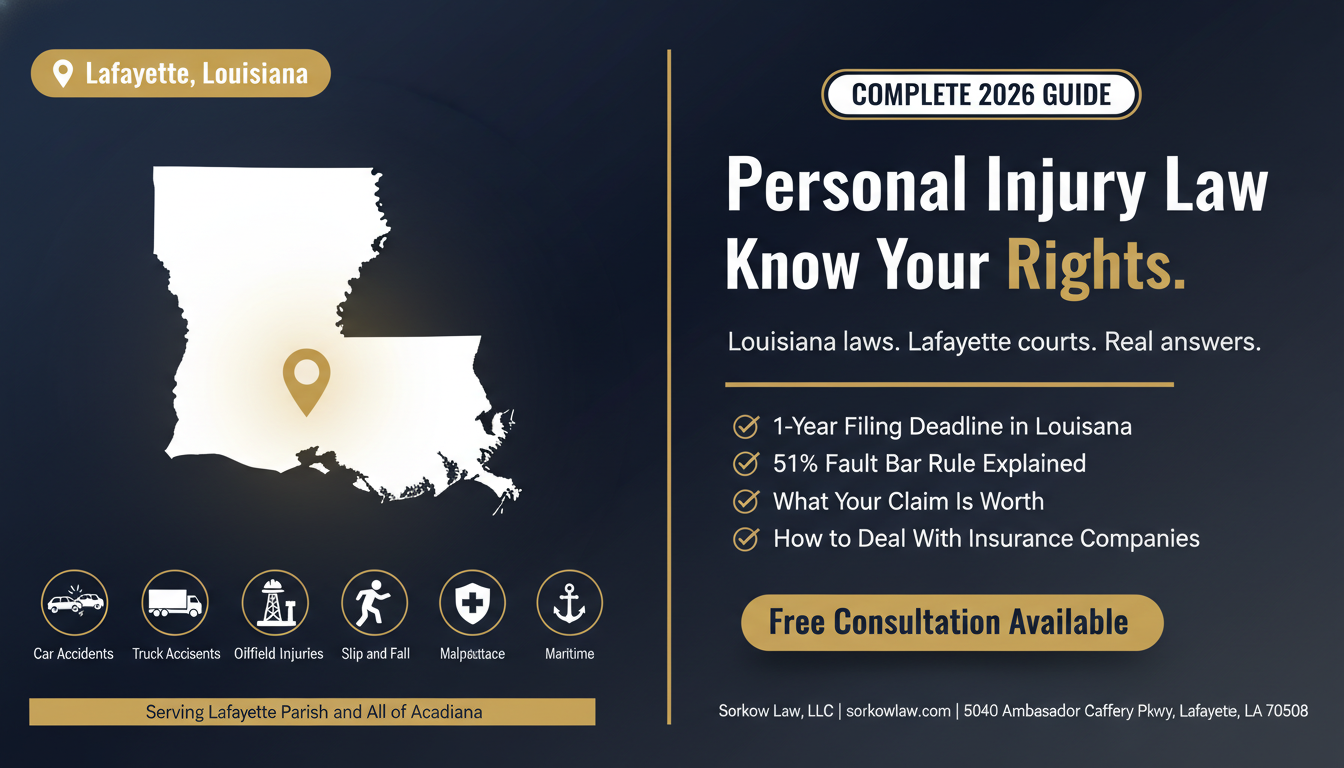
Every year, thousands of Louisiana residents suffer injuries caused by someone else’s negligence. A car accident on I-10. A slip and fall at a Lafayette grocery store. An oilfield accident in Acadiana. A medical mistake that changes everything.
When that happens, most people do not know what their rights are, what the law requires, or what steps they need to take to protect themselves.
This guide was written to change that.
If you were injured in Lafayette, LA, or anywhere in Louisiana, this complete guide to personal injury law explains exactly what you need to know. You will learn how Louisiana law works, what your claim is worth, how fault affects your recovery, and what mistakes to avoid when dealing with insurance companies.
Louisiana has some of the most unique personal injury laws in the United States. The rules here are different from those in every other state. If you apply general legal information to a Louisiana claim, you may lose rights you did not even know you had.
This guide covers Louisiana law specifically, with a focus on Lafayette Parish and the surrounding Acadiana region.
Understanding Personal Injury Law
What Personal Injury Law Covers
Personal injury law is the area of civil law that allows an injured person to seek financial compensation from the party responsible for causing their injury.
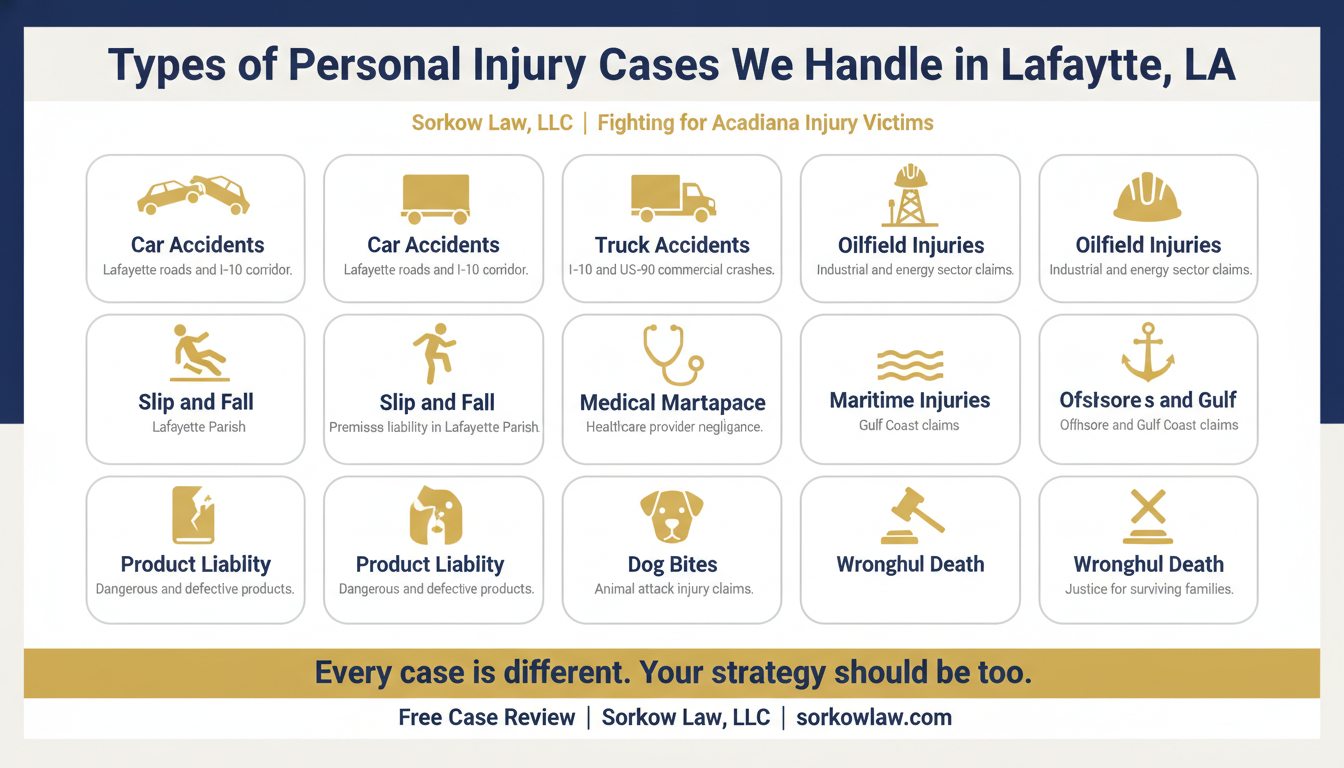
Personal injury law covers a wide range of situations, including car accidents, truck accidents, slip and fall incidents, medical malpractice, defective products, dog bites, workplace injuries, and wrongful death.
The injured person, called the plaintiff, files a claim or lawsuit against the at-fault party, called the defendant. If successful, the plaintiff receives monetary compensation, called damages, to cover their losses.
Personal injury law is civil law, not criminal law. The at-fault party does not go to jail. The purpose is financial compensation, not punishment, although punitive damages can apply in certain cases.
The Purpose of Tort Law
Personal injury law falls under a broader legal category called tort law. A tort is a civil wrong that causes harm to another person.
Tort law serves three main purposes. First, it compensates victims for the losses they suffer due to someone else’s negligence or wrongful conduct. Second, it deters unsafe behavior by making people and businesses financially responsible for the harm they cause. Third, it shifts the cost of an injury from the innocent victim to the party at fault.
In Louisiana, tort law is governed primarily by the Louisiana Civil Code, which is rooted in French and Spanish civil law tradition rather than the English common law system used by other states. This distinction matters because Louisiana courts apply different legal standards and procedures than courts in other states.
Who Can Be Held Liable in a Personal Injury Case
Liability in a personal injury case is not always limited to one person. Multiple parties can share fault for the same injury.
Potentially liable parties in a personal injury case include individual drivers, property owners, employers, product manufacturers, medical providers, government agencies, and contractors.
For example, in a truck accident on US-90 near Lafayette, the truck driver, the trucking company, the cargo loading company, and even a vehicle manufacturer could each share a portion of liability depending on the facts.
Louisiana law uses a system called comparative fault to assign percentages of responsibility to each party. Your compensation is calculated based on those fault percentages.
If you believe another party is responsible for your injury, our Lafayette personal injury attorneys can evaluate your case and identify all liable parties.
Core Elements of a Valid Personal Injury Claim
To win a personal injury case in Louisiana, you must prove four legal elements. If any one of these elements is missing, your claim will fail regardless of how serious your injury is.
Duty of Care
Duty of care means the defendant had a legal obligation to act reasonably to avoid harming others.
Every driver on a Lafayette road has a duty to follow traffic laws and drive safely. A property owner has a duty to maintain safe conditions for visitors. A doctor has a duty to meet the accepted standard of medical care.
Duty is usually the easiest element to establish because the law defines it in most situations.
Breach of Duty
A breach of duty occurs when the defendant fails to meet the standard of care required by law.
Running a red light is a breach of the duty to drive safely. Leaving a wet floor unmarked in a store is a breach of the duty to maintain safe premises. Prescribing the wrong medication is a breach of the medical standard of care.
To prove breach, you must show what a reasonable person in the same situation would have done and demonstrate that the defendant failed to meet that standard.
Causation
Causation requires proving that the defendant’s breach of duty directly caused your injury.
Louisiana courts apply a two-part causation test. The first part, called cause-in-fact, asks whether the injury would have occurred but for the defendant’s negligence. The second part, called legal causation or proximate cause, asks whether the connection between the negligence and the injury is close enough that holding the defendant responsible is fair and reasonable.
Causation is often the most contested element in personal injury cases, especially when the defendant argues that your injury was caused by something else, such as a pre-existing condition.
Damages
Damages are the actual losses you suffered as a result of the injury. You cannot bring a personal injury claim in Louisiana unless you have suffered real, measurable harm.
Damages include medical bills, lost income, pain and suffering, emotional distress, and other losses. The value of your damages directly determines the value of your case.
Even if you prove duty, breach, and causation, you will not recover compensation without demonstrating specific, documented damages.
Louisiana Personal Injury Laws That Affect Your Claim
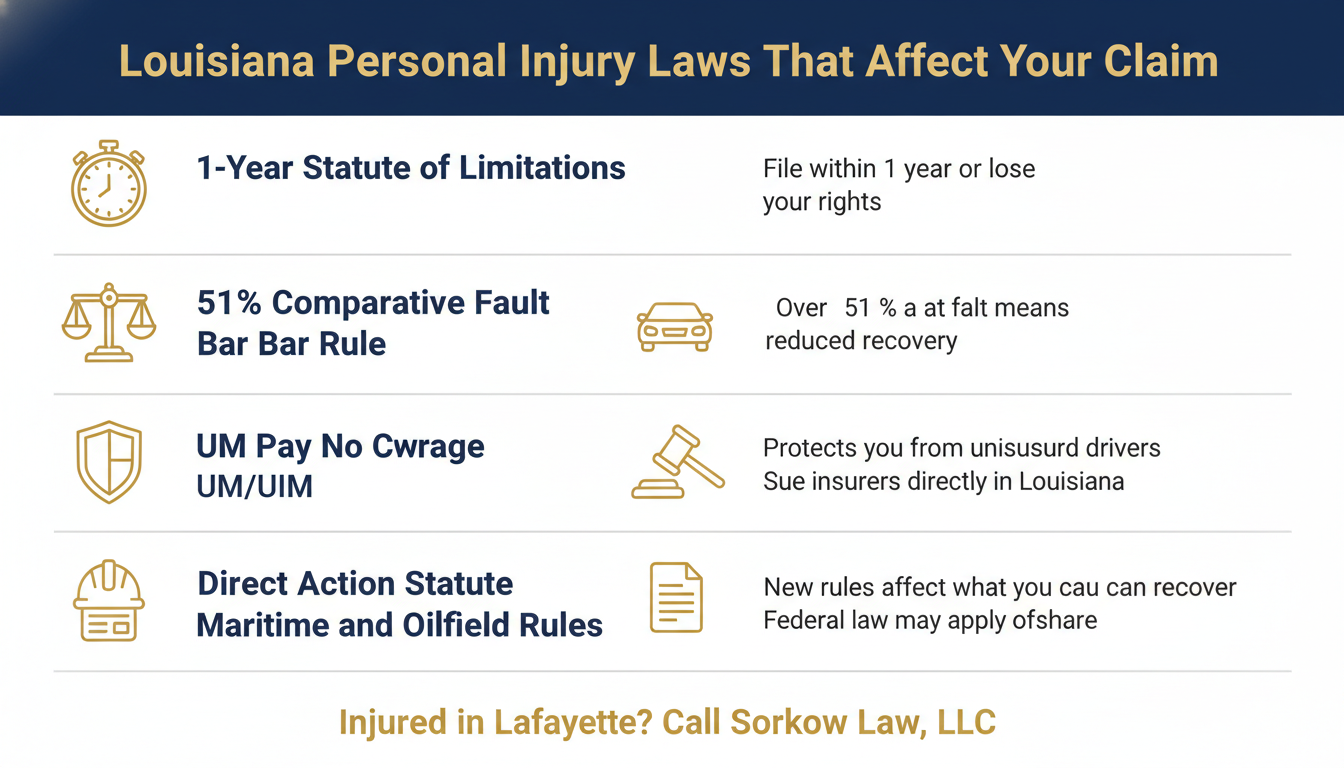
Louisiana’s legal system is unlike any other state in the country. Several state-specific laws directly affect how personal injury claims are filed, calculated, and resolved.
Louisiana Statute of Limitations Explained
The statute of limitations is the deadline for filing a personal injury lawsuit. In Louisiana, that deadline is one year from the date of the accident or injury.
This is one of the shortest filing deadlines in the United States. Most states allow two to three years. Louisiana allows only one year.
If you miss this deadline, the court will almost certainly dismiss your case regardless of how strong it is. You will lose the right to pursue compensation permanently.
There are limited exceptions. The clock may be paused, called “tolled,” if the injured person is a minor, if the defendant concealed their identity, or if the injury was not discovered immediately. However, these exceptions are narrow and cannot be assumed to apply to your case.
If you were injured in Lafayette or anywhere in Louisiana, contact a personal injury lawyer as soon as possible to ensure your deadline is protected.
Modified Comparative Fault and the 51% Bar Rule
Louisiana follows a modified comparative fault system under Louisiana Civil Code Article 2323.
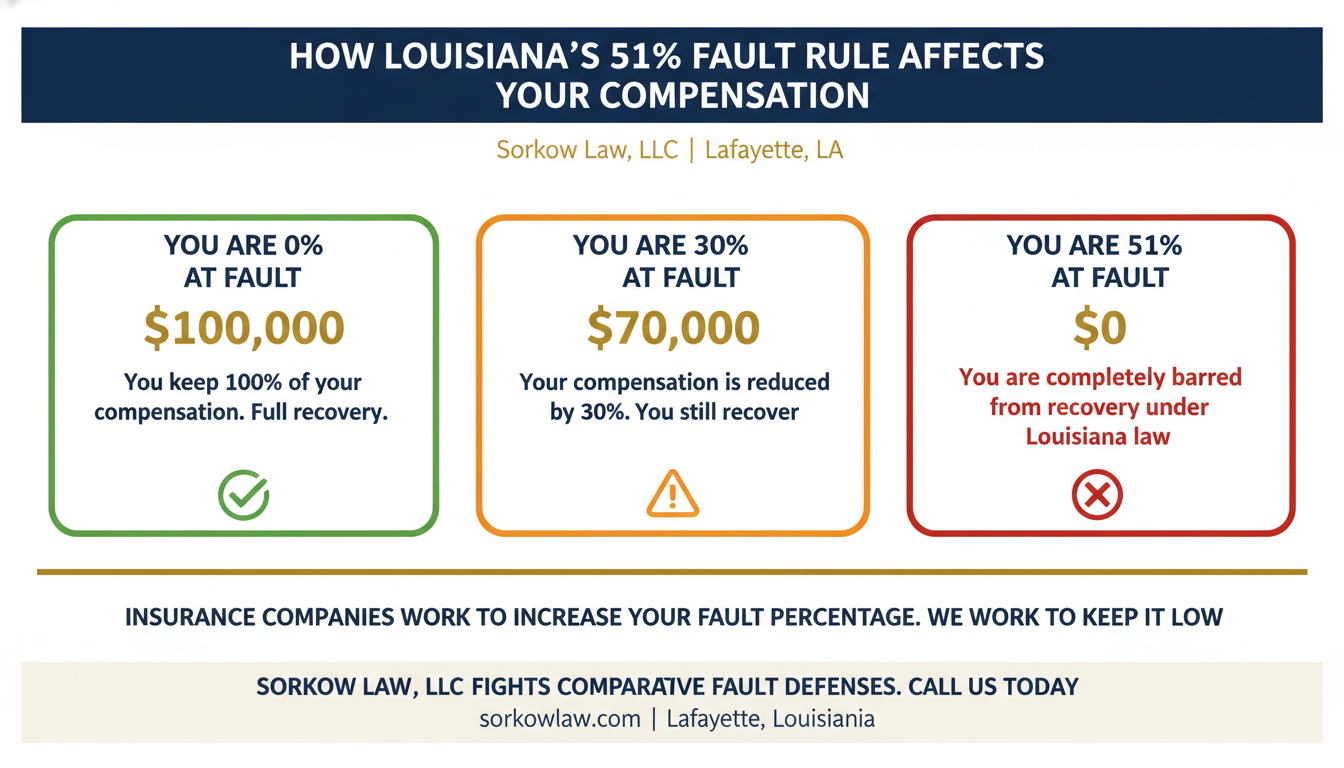
Under this system, fault is assigned as a percentage to each party involved. Your compensation is reduced by your percentage of fault.
The critical rule in Louisiana is the 51% bar. If you are found to be 51% or more at fault for the accident, you are completely barred from recovering any compensation.
If you are found to be 50% or less at fault, you can still recover damages, but your award will be reduced by your fault percentage.
How Shared Fault Reduces Compensation
Here is how the 51% bar rule works in practice.
Suppose your total damages are $100,000 and you are found to be 30% at fault. Your compensation is reduced by 30%, leaving you with $70,000.
If you are found to be 51% at fault, you receive nothing.
This is why insurance companies aggressively try to shift blame onto injured claimants. Even a small increase in your assigned fault percentage significantly reduces what they owe you. This is also why having a personal injury attorney represent you during fault disputes is critically important.
Understanding Louisiana’s No Pay No Play Law
Louisiana Revised Statute 32:866 is known as the No Pay No Play law. This law is unique to Louisiana and can seriously reduce the compensation available to uninsured drivers who are injured in accidents.
Under this law, if you were driving without the minimum required auto insurance at the time of the accident, you cannot recover the first $15,000 of bodily injury damages or the first $25,000 of property damage from the at-fault driver’s insurance, even if the other driver was 100% at fault.
This law does not apply if you were not operating a vehicle or if the at-fault driver was driving under the influence of alcohol or drugs.
The No Pay No Play law is one of the most important reasons Louisiana drivers must maintain at least the minimum required auto insurance coverage.
Louisiana Direct Action Rules
Louisiana is one of a small number of states with a direct action statute. Under Louisiana Revised Statute 22:1269, an injured person can file a lawsuit directly against the at-fault party’s insurance company, rather than only suing the at-fault individual.
This is significant because it allows plaintiffs to hold the insurer directly accountable in court. The insurer becomes a named defendant in the lawsuit.
In most other states, plaintiffs must first obtain a judgment against the at-fault party and then seek payment from the insurer separately. Louisiana eliminates that step.
Uninsured and Underinsured Motorist Coverage in Louisiana
Louisiana has one of the highest rates of uninsured drivers in the country. The Louisiana Department of Insurance provides official guidance on required auto insurance coverage and your UM/UIM rights as a Louisiana driver.
UM coverage pays your damages when the at-fault driver has no insurance or insufficient insurance to cover your losses.
In Louisiana, UM coverage is automatically included in auto insurance policies unless you sign a written waiver rejecting it. If you signed such a waiver without fully understanding it, you may have unknowingly given up significant protection.
Underinsured motorist coverage, called UIM coverage, applies when the at-fault driver has insurance but their policy limits are too low to cover all of your damages.
If you were injured by an uninsured or underinsured driver in Lafayette, your own UM/UIM policy may be your primary source of recovery.
2026 Changes Affecting Medical Damage Recovery
Louisiana continues to evolve its laws around medical damage caps and recovery limits. Recent legislative activity has affected how medical expenses are calculated in personal injury cases, particularly regarding the amounts that can be claimed for past and future medical treatment.
These changes affect what evidence is admissible to prove medical damages and how juries are instructed to calculate medical expenses. The rules governing what dollar amounts can be presented to a jury have shifted, and these shifts can significantly affect total case value.
Because these laws are actively changing in 2026, it is important to consult with a Lafayette personal injury attorney who is current on the latest legislative updates and how they apply to your specific claim.
Personal Injury Claims in Lafayette, LA
Common Causes of Injury Claims in Lafayette
Lafayette is the economic and cultural hub of Acadiana. Its location at the intersection of major highways, its active petrochemical and oilfield industry, and its growing population create a specific set of injury risks that are reflected in the local claims landscape.
The most common causes of personal injury claims in Lafayette include motor vehicle accidents, commercial truck accidents, oilfield and industrial accidents, slip and fall incidents at commercial properties, dog bites, and injuries caused by defective products.
Car Accidents in Lafayette
Car accidents are the leading cause of personal injury claims in Lafayette Parish. Heavy traffic on Ambassador Caffery Parkway, Johnston Street, Pinhook Road, and the I-10 interchange creates frequent collision risks.
Lafayette’s rapid commercial development means intersections and road configurations change regularly, contributing to driver confusion and accident risk.
Common car accident injuries seen in Lafayette claims include whiplash, traumatic brain injuries, spinal injuries, broken bones, and soft tissue damage. Even accidents at moderate speeds can cause injuries that require months of treatment and result in significant lost income.
Truck Accidents on I-10 and US-90
Interstate 10 and US Highway 90 are major commercial trucking corridors that run through Lafayette and the surrounding Acadiana region. Heavy commercial truck traffic on these routes creates a serious accident risk for passenger vehicle drivers.
Truck accidents are fundamentally different from car accidents. Commercial trucks can weigh up to 80,000 pounds. The forces involved in a collision are far greater. Injuries are typically more severe.
Truck accident claims are also legally more complex. Multiple parties may be liable, including the driver, the trucking company, the cargo loader, and the truck manufacturer. Federal trucking regulations under the Federal Motor Carrier Safety Administration apply alongside Louisiana state law. Evidence such as driver logs, electronic logging device data, and black box data must be preserved quickly, or it may be lost.
Oilfield and Industrial Injury Claims
The Lafayette area is home to one of the most active oilfields and energy service industries in the country. Oilfield and industrial workplaces carry some of the highest injury risks of any industry.
Common oilfield injuries include explosions, falls from height, equipment failures, chemical exposure, and transportation accidents on well sites and industrial facilities.
Oilfield injury claims often involve a combination of workers’ compensation law, general maritime law if offshore work is involved, and third-party personal injury claims against non-employer defendants. Identifying all available avenues of recovery is essential to maximizing compensation in these cases.
What to Know About Filing a Claim in Lafayette Parish
Personal injury claims in Lafayette Parish are filed in the 15th Judicial District Court, which serves Lafayette, Acadia, and Vermilion parishes.
Louisiana’s one-year statute of limitations applies to claims filed here. Local court rules, filing procedures, and judicial practices in the 15th Judicial District can affect how your case moves through the system.
Working with a personal injury attorney who is familiar with Lafayette Parish courts, local judges, and local jury tendencies gives your case a meaningful practical advantage.
Common Types of Personal Injury Cases
Motor Vehicle Accident Claims
Motor vehicle accident claims include car accidents, motorcycle accidents, pedestrian accidents, and bicycle accidents. These are the most frequently filed personal injury claims in Louisiana.
To succeed in a motor vehicle accident claim, you must establish that the other driver was negligent, that the negligence caused the accident, and that the accident caused your specific injuries and damages.
Louisiana requires all drivers to carry minimum liability insurance. However, minimum coverage limits are often insufficient to fully compensate serious injury victims, which is why UM/UIM coverage is so important.
Premises Liability and Slip and Fall Claims
Property owners in Louisiana have a legal duty to keep their premises reasonably safe for visitors. When they fail to do so, and someone is injured, the property owner can be held liable under premises liability law.
Slip and fall claims are the most common type of premises liability case. These cases arise from wet floors, uneven pavement, poor lighting, broken stairs, and other dangerous conditions.
Under Louisiana Civil Code Article 2317.1, to succeed in a premises liability claim, you must prove that the property owner knew or should have known about the dangerous condition and failed to repair it or warn visitors.
Medical Malpractice Cases
Medical malpractice occurs when a healthcare provider fails to meet the accepted standard of care, and that failure causes patient harm.
Common medical malpractice claims in Louisiana include surgical errors, misdiagnosis or delayed diagnosis, medication errors, birth injuries, and anesthesia mistakes.
Medical malpractice cases in Louisiana are governed by the Louisiana Medical Malpractice Act, which imposes unique procedural requirements, damage caps, and filing deadlines that do not apply to other personal injury cases. These rules are covered in detail in the medical malpractice section of this guide.
Product Liability Claims
Product liability law holds manufacturers, distributors, and sellers responsible for injuries caused by defective or unreasonably dangerous products.
In Louisiana, product liability claims are governed by the Louisiana Products Liability Act. A product can be defective in three ways: defective design, defective manufacturing, or failure to provide adequate warnings.
Common product liability claims involve defective vehicles, unsafe medications, dangerous medical devices, and defective industrial equipment, which is particularly relevant for oilfield workers in the Lafayette area.
Dog Bite and Animal Attack Claims
Louisiana Revised Statute 14:329.6 and general negligence law govern dog bite and animal attack claims in Louisiana. Louisiana applies a negligence-based standard, meaning the injured person must show that the owner knew or should have known the animal had dangerous tendencies.
Dog bite injuries can be severe, particularly for children. Beyond physical wounds, victims often suffer lasting psychological trauma.
In Lafayette, dog bite claims can be pursued against the animal’s owner and, in some cases, against a property owner where the attack occurred if they knew the animal was present and dangerous.
Assault and Battery Injury Claims
When someone intentionally injures you, you have the right to file a civil personal injury claim regardless of whether criminal charges are filed.
Civil assault and battery claims allow injury victims to seek compensation for medical expenses, lost income, pain and suffering, and emotional distress from the person who harmed them.
These claims are pursued separately from any criminal prosecution. Even if the attacker is not convicted criminally, you may still succeed in a civil claim under a lower burden of proof.
Wrongful Death Claims
When a person dies as a result of someone else’s negligence or intentional act, Louisiana law allows certain surviving family members to file a wrongful death claim.
Under Louisiana Civil Code Articles 2315.1 and 2315.2, the right to file a wrongful death claim belongs first to the surviving spouse and children, then to the parents, and then to siblings if no closer relatives survive.
Wrongful death damages can include funeral and burial expenses, loss of the deceased person’s income and financial support, loss of love and companionship, and the surviving family members’ own grief and emotional distress.
Claims Involving Minors and Court Approval Requirements
When a personal injury claim involves an injured minor, Louisiana law requires court approval of any settlement.
A parent or guardian cannot simply accept a settlement on behalf of a child without judicial oversight. The court reviews the settlement to ensure it is fair and in the best interest of the minor.
Settlement funds for a minor may be required to be held in a protected account or structured annuity until the child reaches the age of majority. Failing to follow these procedures can create legal complications and may expose the parent or guardian to liability.
Special Types of Personal Injury Claims
Catastrophic Injury Cases
Catastrophic injuries are those that permanently alter a person’s ability to live, work, and function independently. These include traumatic brain injuries, spinal cord injuries resulting in paralysis, severe burn injuries, amputations, and injuries causing permanent disability.
Catastrophic injury cases require a fundamentally different approach to damages calculation. Standard economic losses like medical bills and lost wages do not capture the full extent of harm. Lifetime care costs, loss of earning capacity, home modification expenses, and the full scope of non-economic suffering must be carefully documented and presented.
These cases often require life care planners, vocational experts, and economic experts to properly quantify damages. The stakes are high, and so is the complexity.
Commercial Truck Accident Claims
Commercial truck accident claims are distinct from standard car accident claims in both the law that applies and the investigation required.
Federal Motor Carrier Safety Administration regulations govern commercial trucking and establish strict standards for driver hours, vehicle maintenance, cargo loading, and driver qualification. Violations of these regulations can establish negligence in a truck accident claim.
Critical evidence in truck accident cases includes the truck’s electronic logging device data, the driver’s qualification file, maintenance records, cargo manifests, and dashcam footage. This evidence must be preserved immediately through a legal process called a spoliation letter. If not preserved quickly, it may be overwritten or destroyed.
Maritime and Offshore Injury Cases
The Lafayette area’s proximity to Gulf of Mexico oil and gas operations means that maritime and offshore injury claims are more common here than in most parts of the country.
Workers injured on vessels, platforms, or in navigable waters may have rights under federal maritime law rather than, or in addition to, Louisiana state law. The Jones Act, the Longshore and Harbor Workers’ Compensation Act, and the general maritime doctrine of unseaworthiness each provide different rights and remedies depending on the worker’s specific job classification and the location of the injury.
Maritime injury claims are highly specialized. The law that applies, the deadlines, and the procedures differ significantly from standard personal injury claims. An attorney with specific maritime law experience is essential in these cases.
Claims Against Government Entities
Suing a government entity in Louisiana requires following specific procedures that differ from standard personal injury lawsuits.
Under the Louisiana Governmental Claims Act, claims against state agencies, state employees, and political subdivisions of the state must follow special notice requirements and procedural rules. Damage caps apply to claims against government entities.
Claims against the City of Lafayette, Lafayette Parish, the Louisiana Department of Transportation and Development, or other government bodies must typically be preceded by a formal notice of claim filed within a specific timeframe.
Missing the notice deadline can permanently bar your claim against a government defendant even if the claim would otherwise be valid.
What Compensation Can You Recover in a Personal Injury Case
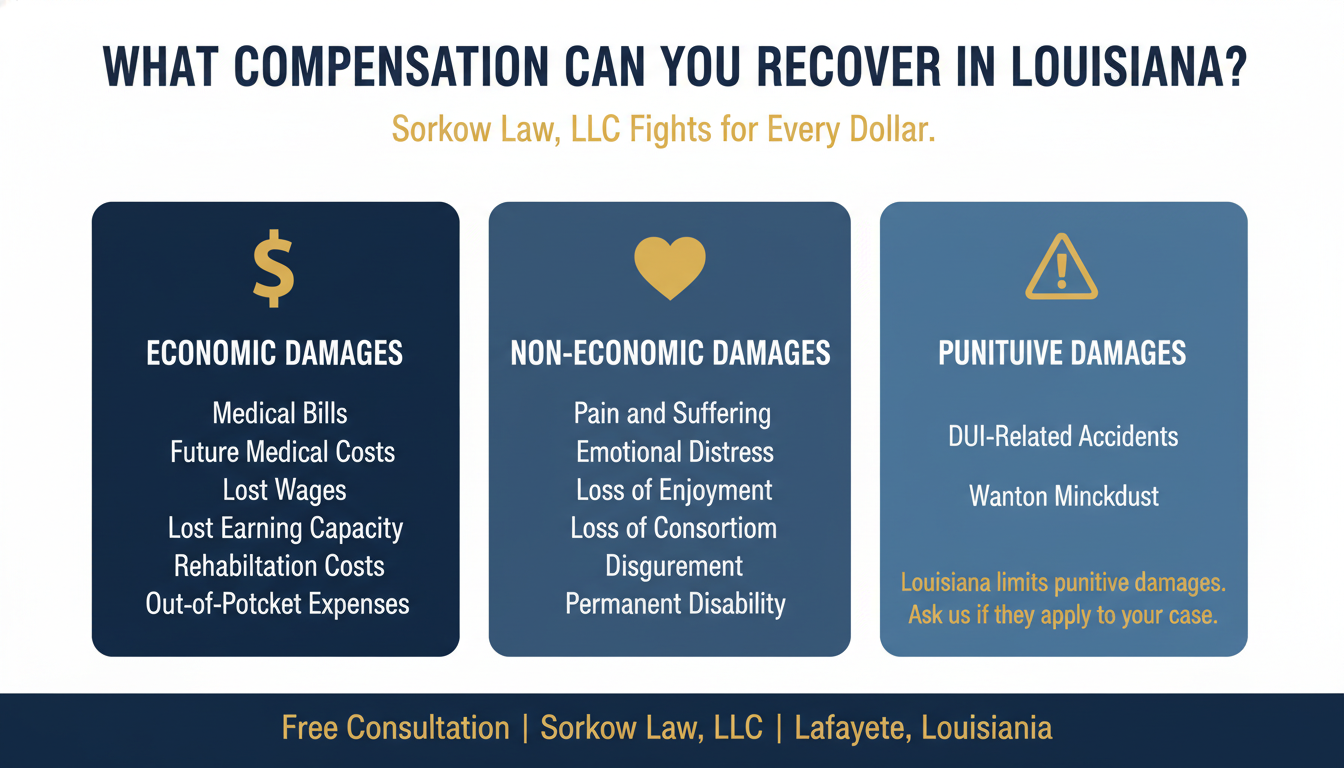
Economic Damages
Economic damages are the financial losses that can be calculated with specific dollar amounts.
Economic damages in a Louisiana personal injury case include past and future medical expenses, lost wages and lost earning capacity, costs of rehabilitation and physical therapy, costs of home health care or in-home assistance, property damage, and other out-of-pocket expenses directly caused by the injury.
These damages are documented through medical bills, employer records, tax returns, expert testimony, and other evidence. The more thoroughly documented your economic damages are, the stronger your claim.
Non-Economic Damages
Non-economic damages compensate for losses that do not have a fixed dollar value but are nonetheless real and significant.
Non-economic damages include physical pain and suffering, mental anguish and emotional distress, loss of enjoyment of life, loss of consortium, disfigurement, and permanent disability.
Louisiana does not cap non-economic damages in most standard personal injury cases. However, medical malpractice claims are subject to a separate cap under the Louisiana Medical Malpractice Act.
Calculating non-economic damages requires presenting compelling evidence of how the injury has affected every aspect of your daily life, relationships, and mental health.
Punitive Damages
Louisiana does not generally allow punitive damages in personal injury cases. Louisiana Civil Code Article 2315.4 is the primary exception.
Under that statute, punitive damages are available when the defendant caused injury through an act of wanton or reckless disregard for the rights and safety of others while operating a vehicle under the influence of alcohol or drugs.
In practice, punitive damages in Louisiana personal injury cases arise most commonly in drunk driving accident cases.
Future Medical Expenses and Long-Term Care Damages
For serious injuries requiring ongoing treatment, future medical expenses are a critical component of damages.
Future medical expenses can include future surgeries, ongoing medication costs, physical therapy, psychological counseling, assistive devices, and long-term care or nursing home costs.
Proving future medical damages requires expert medical testimony. A treating physician or medical expert must explain to a reasonable degree of medical certainty what future treatment the injured person will need and what that treatment will cost.
Life care planners are often retained in catastrophic injury cases to create a comprehensive plan projecting lifetime medical and care costs.
Understanding Medical Liens and Health Insurance Subrogation
When your health insurance, Medicare, or Medicaid pays for medical treatment related to your personal injury, those payers may have the legal right to recover what they paid from your settlement or judgment. This right is called subrogation.
If you receive a settlement, your health insurer or government payer will typically assert a lien against your recovery. That lien must be resolved before or at the time you receive your settlement funds.
Failing to resolve medical liens properly can expose you to personal liability even after your case is settled. In many cases, liens can be negotiated down, but the process requires careful legal attention.
How Medicare and Medicaid Liens Affect Your Settlement
Medicare and Medicaid liens are governed by federal law and carry serious consequences if mishandled.
Medicare has the right to recover any conditional payments it made for injury-related treatment from your personal injury settlement. This is called the Medicare Secondary Payer Act.
If you are a Medicare or Medicaid recipient and you settle a personal injury claim without properly addressing the lien, the government can sue you and your attorney directly to recover what was paid.
Resolving Medicare and Medicaid liens requires formal interaction with the Centers for Medicare and Medicaid Services and, in many cases, negotiation to reduce the lien amount. An experienced personal injury attorney manages this process as part of your case resolution.
What Determines the Value of a Personal Injury Case
Factors That Affect Settlement Amounts
No two personal injury cases have the same value. Many factors determine what a specific case is worth.
Key factors include the severity and permanence of your injuries, the total amount of your medical expenses, the amount of income you lost, the clarity of liability, the insurance coverage available, the strength of your evidence, and the jurisdiction where the case is filed.
In Lafayette specifically, local jury tendencies and the judicial environment of the 15th Judicial District Court can also influence settlement values, since both sides evaluate cases in light of what a local jury might award.
How Fault Impacts Case Value
Under Louisiana’s comparative fault system, your percentage of fault directly reduces your recovery.
If you are 20% at fault, your $100,000 case becomes an $80,000 recovery. If you are 51% at fault, you recover nothing.
Insurance companies know this and will work aggressively to assign as much fault to you as possible. Their adjusters are trained to ask questions, review your statements, and find evidence that shifts blame in their favor. Having an attorney who understands how to counter these tactics preserves your case value.
How Damages Are Calculated
Economic damages are calculated by adding up documented financial losses, including all past and projected future costs related to the injury.
Non-economic damages are calculated differently because they have no fixed price. Methods used include the per diem method, which assigns a daily dollar value to pain and suffering and multiplies it by the number of days the victim has suffered, and the multiplier method, which multiplies total economic damages by a number, typically between 1.5 and 5, based on the severity of the injury.
Courts and insurance companies use both methods. An experienced attorney will apply the method that produces the strongest result for your specific case.
Pre-Existing Conditions and How Insurers Use Them Against You
Insurance companies frequently argue that your injuries were not caused by the accident but were pre-existing conditions you already had before the incident.
Louisiana courts apply what is called the eggshell plaintiff rule. Under this rule, a defendant takes the victim as they find them. If the accident aggravated a pre-existing condition, the defendant is still responsible for the aggravation, even if the same accident would not have injured a healthier person.
The key is proving the difference between your condition before the accident and your condition after it. Medical records documenting your health prior to the accident, combined with expert medical testimony, are essential to overcoming pre-existing condition defenses.
What Can Reduce Your Compensation
Several factors can reduce the compensation you receive in a personal injury case.
Your own percentage of fault reduces your recovery dollar for dollar. Gaps in medical treatment give insurance companies grounds to argue your injuries were not serious or were not caused by the accident. Statements you make to insurance adjusters can be used to minimize your claim. Social media posts can be used as evidence against you. Failure to follow your doctor’s treatment plan is used to argue that you failed to mitigate your damages.
Understanding these risks from the beginning and avoiding common mistakes is one of the most valuable things an attorney can do for your case.
Steps to Protect Your Rights After an Accident
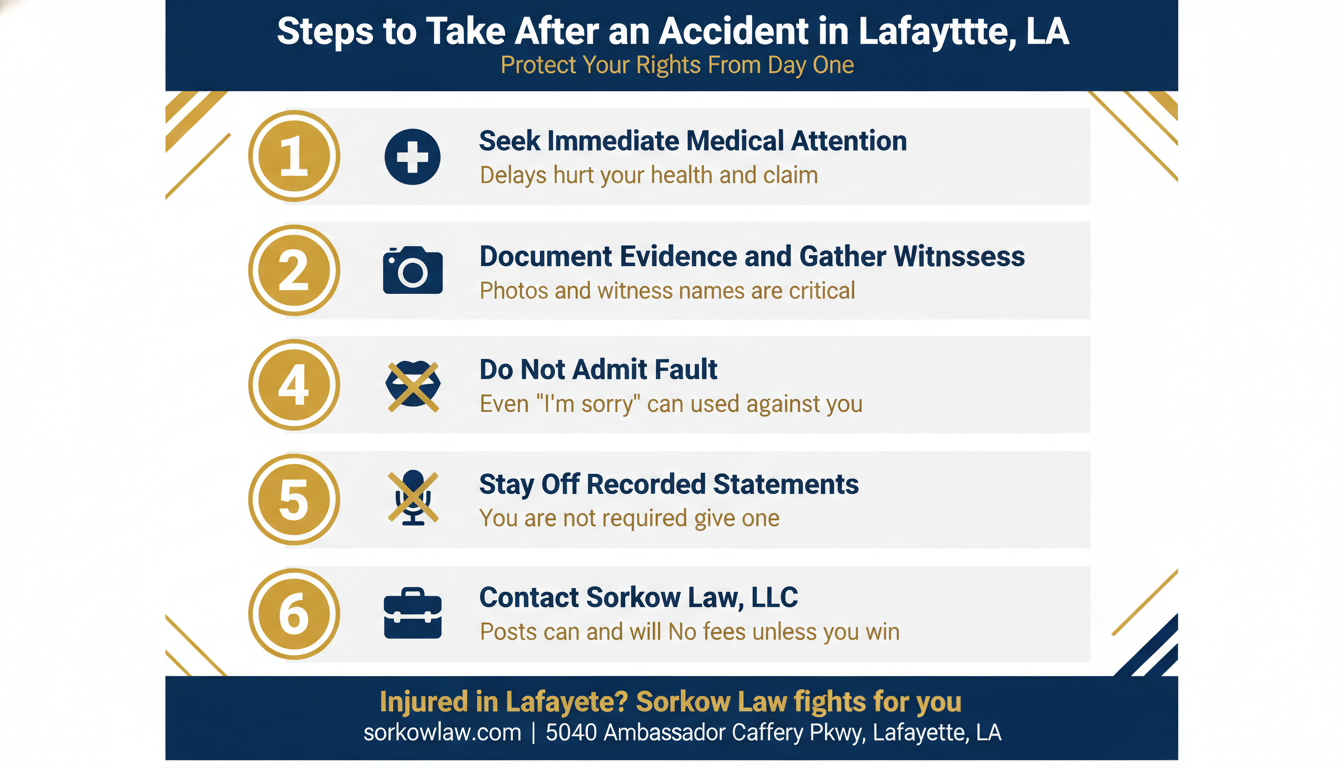
Seek Immediate Medical Attention
Getting medical care immediately after an accident is the single most important step you can take, for your health and for your legal claim.
Even if you feel relatively fine, many serious injuries do not produce obvious symptoms right away. Traumatic brain injuries, internal bleeding, and spinal damage can worsen over hours or days without immediate pain.
From a legal standpoint, a gap between the accident and your first medical visit gives insurance companies a powerful argument that your injuries were not caused by the accident or are not serious. Documentation of injuries starting from the date of the accident is foundational to your claim.
Document Evidence and Gather Witness Information
If you are physically able to do so at the scene, take photographs and video of the vehicles involved, the road conditions, any visible injuries, and the surrounding area.
Get the names, phone numbers, and addresses of all witnesses. Witness testimony often determines the outcome of disputed liability cases.
Preserve everything you have. Keep all medical bills, records, insurance correspondence, and documentation of missed work. A well-documented file is a stronger claim.
Avoid Admitting Fault
Do not apologize or say anything at the accident scene that could be interpreted as an admission of fault. Statements like “I did not see you” or “I am sorry” can be used against you even if you had no legal responsibility for the accident.
Give basic factual information to law enforcement, but avoid speculating about what happened or who caused the accident. Let the investigation determine fault.
Avoid Giving Recorded Statements
After an accident, the at-fault party’s insurance company will typically contact you quickly and ask for a recorded statement about the accident and your injuries.
You are not legally required to give a recorded statement to someone else’s insurance company.
These statements are not taken to help you. They are taken to find inconsistencies, minimize your injuries, and build defenses against your claim. Insurance adjusters are trained professionals skilled at asking questions in ways that produce answers favorable to the insurer.
Decline politely and refer them to your attorney. If you have not yet hired an attorney, say that you need time to consult with one before making any recorded statement.
Social Media Mistakes That Can Hurt Your Claim
Insurance companies and defense attorneys routinely monitor the social media accounts of personal injury claimants.
A photograph of you at a social event, a post about a physical activity, or even a comment saying you are feeling better can be taken out of context and used to undermine your injury claim.
During your case, avoid posting anything about the accident, your injuries, your medical treatment, or your daily activities. Review your privacy settings, but understand that privacy settings are not a guarantee of protection. The safest approach is to minimize all social media activity until your case is resolved.
Contact a Personal Injury Lawyer Early
Contacting a personal injury attorney as early as possible after your accident protects your rights in ways that nothing else can.
An attorney can preserve critical evidence before it disappears, handle all communication with insurance companies on your behalf, identify all potential defendants and insurance policies that apply to your case, ensure your claim is filed before the one-year Louisiana deadline, and guide every decision you make during the process.
Most personal injury attorneys in Lafayette offer free consultations and handle cases on a contingency fee basis.
Dealing With Insurance Companies After an Accident
Common Insurance Adjuster Tactics
Insurance adjusters work for the insurance company, not for you. Their job is to resolve your claim for as little money as possible.
Common tactics include contacting you immediately after the accident before you have legal representation, asking leading questions designed to elicit statements that reduce your claim, offering a fast settlement before the full extent of your injuries is known, disputing the severity of your injuries or their connection to the accident, and arguing that your pre-existing conditions are responsible for your current symptoms.
Recognizing these tactics is the first step to protecting yourself from them.
How Settlement Offers Are Evaluated
Insurance companies evaluate settlement offers based on their internal assessment of what a case is worth and what they believe they can get away with paying.
Their evaluation considers the clarity of liability, your documented damages, the strength of your evidence, whether you have legal representation, and their perception of whether you are likely to accept a low offer or push back.
Studies consistently show that injured people represented by attorneys receive significantly higher settlements than those who handle claims on their own, even after attorney fees are deducted.
When Not to Accept a Quick Settlement
Never accept an early settlement offer before you have reached maximum medical improvement, which is the point at which your condition has stabilized, and your doctors can assess the full extent of your injuries.
Accepting a settlement before this point means you may be settling for far less than your case is actually worth. Once you sign a settlement release, you cannot go back and ask for more money, even if your injuries turn out to be worse than expected.
Early settlement offers from insurance companies are almost never the best offer. They are designed to close the claim quickly and cheaply before you understand your full damages.
What to Do if Your Claim Is Denied
If your claim is denied, do not assume the denial is final or legally correct. Insurance companies deny claims for a variety of reasons, some legitimate and some not.
Request a written explanation of the denial. Review it carefully with an attorney. In many cases, a denied claim can be successfully appealed, or additional evidence can be submitted to reverse the decision.
If bad faith claim handling is involved, meaning the insurer denied or delayed your claim without a reasonable basis, Louisiana law allows additional remedies, including penalty damages and attorney fees under Louisiana Revised Statutes 22:1892 and 22:1973.
Handling Uninsured and Underinsured Driver Situations
If the at-fault driver has no insurance or insufficient insurance, your recovery options depend heavily on your own policy.
Your UM/UIM coverage may provide the primary source of recovery. Louisiana law gives you the right to stack UM coverage from multiple policies in certain situations, which can significantly increase the total coverage available.
If you do not have UM coverage because you signed a waiver, the circumstances of that waiver may be worth examining. Waivers that were not properly explained or that do not meet Louisiana’s technical requirements may not be enforceable.
Your Legal Options After an Injury
Filing an Insurance Claim
Most personal injury cases begin with an insurance claim, either against the at-fault party’s liability insurance or against your own coverage.
Filing an insurance claim initiates the claims process and puts the insurer on notice of your damages. Louisiana law requires insurers to acknowledge claims promptly and to act in good faith in evaluating and paying valid claims.
Filing an insurance claim does not waive your right to file a lawsuit if the claim is denied or the settlement offered is inadequate.
Filing a Personal Injury Lawsuit
If the insurance claim does not result in a fair settlement, the next step is filing a personal injury lawsuit in civil court.
In Lafayette, personal injury lawsuits are filed in the 15th Judicial District Court. The lawsuit must be filed within the one-year statute of limitations from the date of injury.
Filing a lawsuit does not necessarily mean your case will go to trial. The vast majority of personal injury lawsuits settle before trial. However, filing a lawsuit signals to the insurance company that you are serious about pursuing full compensation and gives you access to formal legal tools like depositions and discovery.
Mediation and Arbitration Options
Mediation is a voluntary process in which a neutral third party, the mediator, helps both sides negotiate a resolution without going to trial.
Mediation is confidential and non-binding. If mediation does not produce an agreement, you retain the right to proceed to trial. Many Louisiana personal injury cases settle during or shortly after mediation.
Arbitration is a more formal process in which a neutral arbitrator hears evidence and issues a decision. Some insurance policies require arbitration for certain disputes. Unlike mediation, arbitration decisions are typically binding.
When to Take a Case to Trial
Taking a case to trial is sometimes the right decision when the insurance company refuses to make a reasonable settlement offer.
Trial carries risks. Jury verdicts are unpredictable. Trial is expensive and time-consuming. However, the willingness to take a case to trial is often what ultimately compels an insurance company to settle fairly.
An experienced personal injury attorney will evaluate your case honestly and advise you on whether the trial risk is worth taking based on the specific facts, evidence, and damages in your case.
The Personal Injury Claims Process
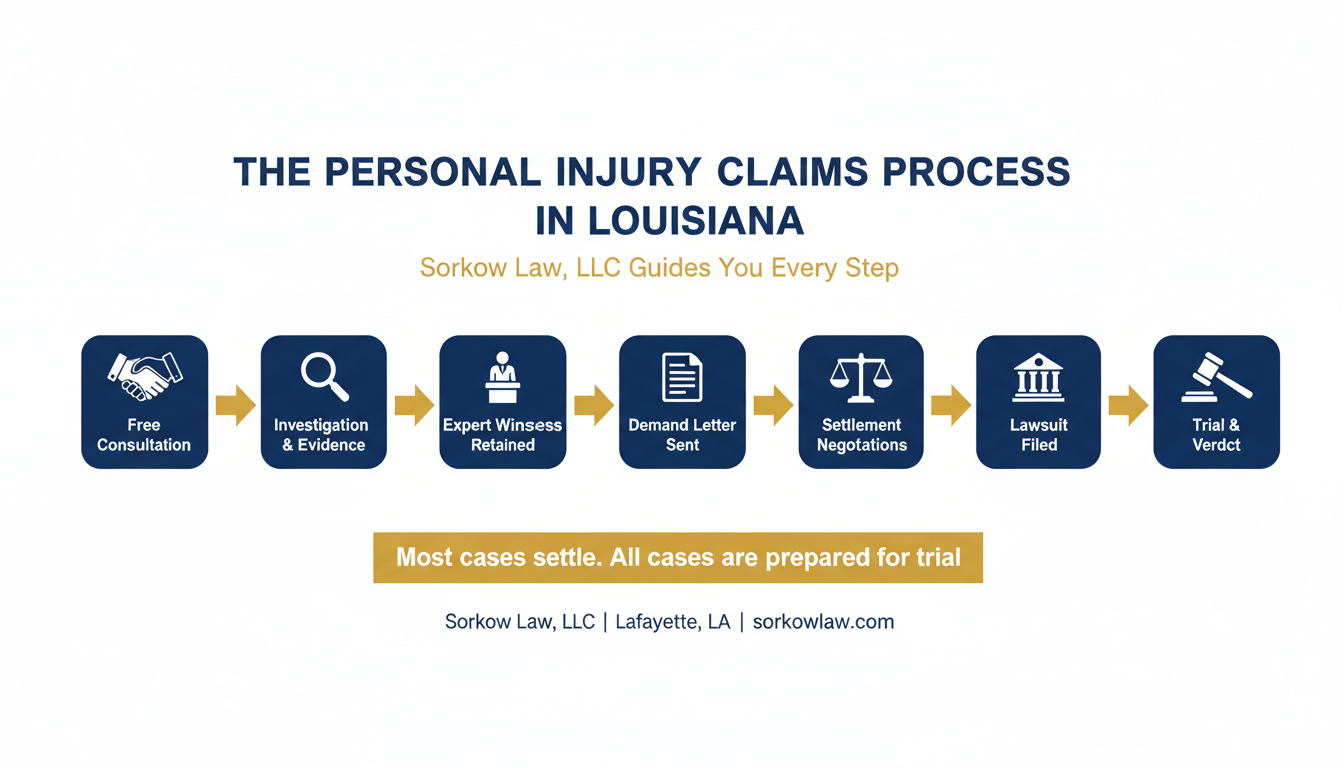
Initial Legal Consultation
The personal injury claims process begins with a consultation with an attorney. Most Lafayette personal injury attorneys offer this consultation at no charge.
During the consultation, you describe the accident, your injuries, and your circumstances. The attorney evaluates whether you have a viable claim, explains your legal options, and discusses the likely value and timeline of your case.
Bring any documents you have, including police reports, medical records, insurance information, and photographs, to your initial consultation.
Investigation and Evidence Collection
Once you hire an attorney, the investigation phase begins. Your attorney and their team will gather all available evidence to support your claim.
Investigation activities include obtaining the police report, reviewing medical records, interviewing witnesses, analyzing accident reconstruction evidence, subpoenaing surveillance footage, requesting black box and EDR data from vehicles, and serving spoliation letters on defendants to require preservation of evidence.
The strength of your case depends heavily on the quality of the evidence gathered during this phase.
The Role of Expert Witnesses in Building Your Case
Expert witnesses are professionals with specialized knowledge who provide testimony that helps the judge or jury understand complex issues in your case.
Common expert witnesses in Louisiana personal injury cases include accident reconstruction engineers who explain how the accident happened, medical experts who testify about the nature and cause of your injuries, vocational rehabilitation experts who assess your reduced ability to work, economic experts who calculate your lost earning capacity, and life care planners who project future medical and care costs for catastrophic injuries.
Expert witness testimony is often decisive in contested liability cases and in cases where the defense disputes the extent or cause of your injuries.
Sending a Demand Letter
After your medical treatment reaches maximum medical improvement and your damages are fully documented, your attorney will send a demand letter to the insurance company.
The demand letter summarizes the facts of the accident, establishes liability, documents your damages in detail, and states a specific settlement demand.
The demand letter opens formal settlement negotiations. The insurance company will typically respond with a counteroffer, and negotiations proceed from there.
Settlement Negotiations
Settlement negotiations are an ongoing process that can begin before a lawsuit is filed and continue up until the day of trial.
Your attorney will evaluate every offer the insurance company makes, advise you on whether it is fair relative to your damages and the risks of litigation, and negotiate aggressively on your behalf.
You, as the client, make the final decision on whether to accept or reject any settlement offer. Your attorney’s job is to give you the information you need to make that decision wisely.
Filing a Lawsuit
If settlement negotiations do not produce an acceptable result, your attorney will file a petition for damages in civil court.
In Louisiana, the initial pleading in a civil lawsuit is called a petition, not a complaint. It is filed with the clerk of the court and formally served on the defendant.
Filing the lawsuit does not mean the case will go to trial. Many cases settle during or after litigation, often as trial approaches and both sides more clearly assess risk.
Discovery Process
Discovery is the formal legal process through which both sides exchange information and evidence.
Discovery tools include written interrogatories, which are formal written questions that must be answered under oath, requests for production of documents, depositions, which are sworn out-of-court testimony, and requests for admission.
In personal injury cases, discovery typically includes obtaining the defendant’s insurance information, driver records, phone records, vehicle maintenance records, and any internal company communications relevant to the case.
Discovery often produces evidence that strengthens the plaintiff’s case or that motivates the defendant to settle.
Trial and Verdict
If the case does not settle, it proceeds to trial. In Louisiana civil courts, personal injury cases can be tried before a jury or before a judge alone, called a bench trial.
At trial, both sides present evidence, call witnesses, and make legal arguments. The jury then deliberates and returns a verdict. If the verdict is in your favor, the court enters a judgment for the amount of damages awarded.
Post-trial motions and appeals can extend the process further. However, a favorable jury verdict is often the event that finally compels a previously resistant insurance company to pay fair compensation.
Medical Malpractice Rules in Louisiana
Louisiana Medical Malpractice Damage Rules
Louisiana’s Medical Malpractice Act imposes a cap on total damages recoverable from private healthcare providers. Currently, total recovery from a private healthcare provider qualified under the Act is capped at $500,000 for all damages arising from a single act of malpractice.
Of that total, the qualified healthcare provider’s direct liability is limited to $100,000. Any amount above $100,000, up to the $500,000 cap, is paid by the Louisiana Patient’s Compensation Fund.
It is important to note that the $500,000 cap does not include future medical expenses, which are paid by the Patient’s Compensation Fund above and beyond the general cap.
These caps do not apply to healthcare providers who are not enrolled in the Louisiana Patient’s Compensation Fund program.
Medical Review Panel Requirements
Before filing a medical malpractice lawsuit against a qualified healthcare provider in Louisiana, the injured patient must first submit the claim to a Medical Review Panel.
The Medical Review Panel consists of three healthcare providers and one attorney who reviews the evidence and issues an opinion on whether the defendant’s conduct fell below the standard of care.
The panel’s opinion is not binding on a court. However, it is admissible as evidence at trial. A favorable panel opinion strengthens your case significantly. An unfavorable opinion does not end your case, but it does make litigation more challenging.
The Medical Review Panel process adds time to medical malpractice claims. The statute of limitations is suspended while the panel review is pending, but the initial claim must still be submitted within the applicable deadline.
Filing Deadlines for Medical Negligence Claims
Medical malpractice claims in Louisiana are subject to Louisiana’s general one-year prescriptive period, which begins when the injured person knew or should have known of the malpractice.
Louisiana also applies an absolute three-year peremptive period. Even if you did not discover the malpractice, no medical malpractice claim can be brought more than three years after the date the malpractice occurred, with very limited exceptions.
Peremption is more strict than prescription in Louisiana law. It cannot be interrupted or suspended in most circumstances. Missing the three-year peremptive period permanently bars your claim.
Common Challenges in Personal Injury Claims
Proving Liability
Proving that another party was legally at fault for your injury is not always straightforward. Disputed liability is one of the most common challenges in personal injury cases.
The defendant may deny being at fault entirely, argue that you caused or contributed to the accident, or claim that a third party was responsible.
Overcoming disputed liability requires solid evidence, witness testimony, expert analysis, and legal arguments that establish the defendant’s negligence to the required standard.
Disputes Over Damages
Even when liability is established, the value of your damages is often contested.
Insurance companies routinely dispute whether all of your medical treatment was necessary, whether your injuries were as severe as claimed, whether future treatment is genuinely required, and whether non-economic losses like pain and suffering are as significant as you contend.
Thorough medical documentation, consistent treatment, and expert testimony are the most effective tools for overcoming damage disputes.
Pre-Existing Condition Defenses
The pre-existing condition defense is used in a large number of personal injury cases. The argument is simple: the defendant claims your current injuries existed before the accident and were not caused by their negligence.
Countering this defense requires documenting your baseline health before the accident, obtaining medical expert testimony comparing your condition before and after, and applying the eggshell plaintiff rule to establish the defendant’s liability for aggravating whatever condition you had.
Comparative Fault Defenses
Defendants and their insurers routinely argue that the injured person was partly or primarily at fault for the accident.
In Louisiana, this matters enormously because of the 51% bar rule. Shifting fault to the plaintiff by even a small percentage reduces the defendant’s exposure. Shifting it above 50% eliminates it entirely.
Your attorney must be prepared to counter comparative fault arguments with evidence and legal argument that accurately and fully assigns responsibility to the defendant.
Delays in Insurance and Litigation
Personal injury claims take time. Even straightforward cases can take months to resolve. Complex cases involving serious injuries, disputed liability, or multiple defendants can take one to three years or longer.
Insurance companies sometimes use delay as a deliberate tactic, hoping that financial pressure will force an injured person to accept a lower settlement.
Understanding that delays are common and planning financially for the timeline your case may require helps you make better decisions throughout the process.
When to Hire a Personal Injury Lawyer
Signs You Need Legal Representation
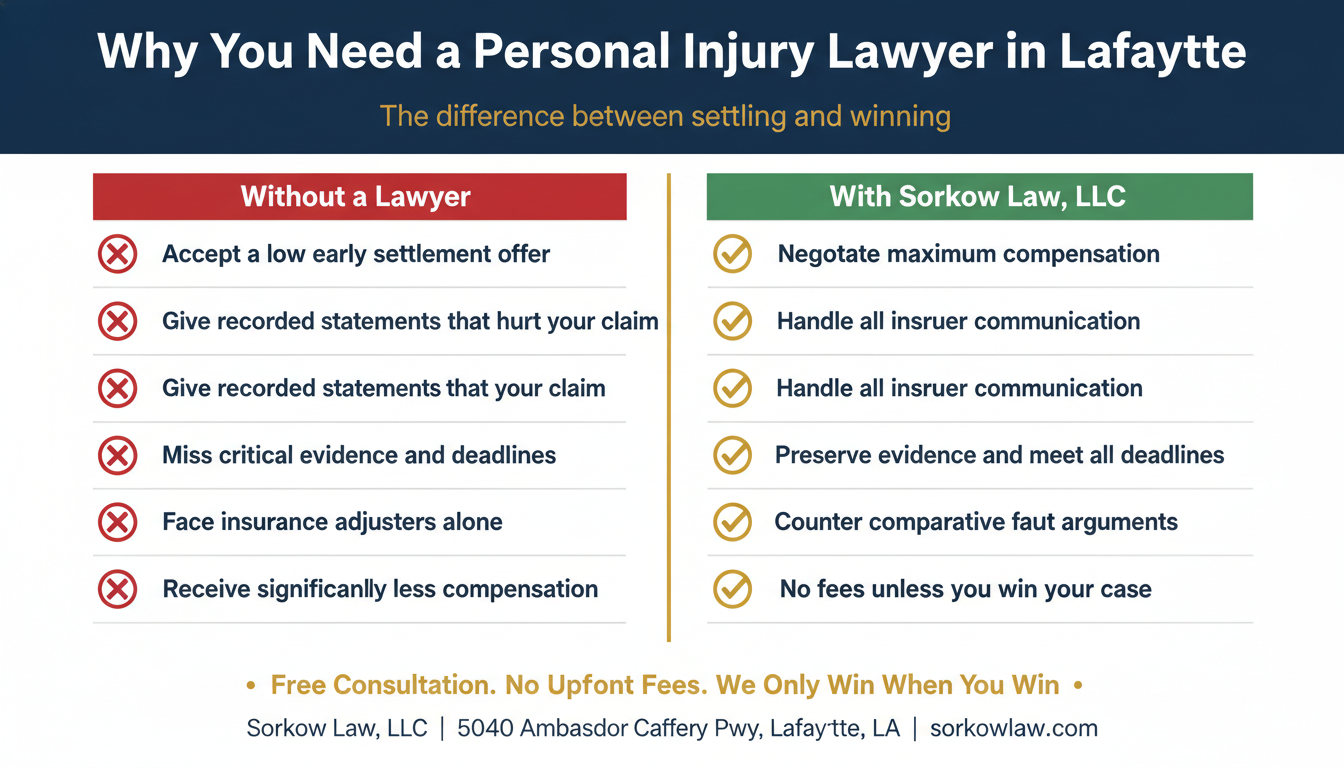
You should hire a personal injury attorney if your injuries are serious or require significant medical treatment, if liability is disputed, if multiple parties are involved, if the insurance company is offering a low settlement or denying your claim, if you have a pre-existing condition that may be used against you, if you are being asked to give a recorded statement, or if the statute of limitations deadline is approaching.
Even in cases that seem straightforward, having an attorney almost always produces a better outcome than handling the claim on your own.
Learn how our Lafayette personal injury lawyers help injury victims recover maximum compensation.
Benefits of Working With a Contingency Fee Attorney
Personal injury attorneys in Louisiana typically work on a contingency fee basis. This means the attorney receives a percentage of your recovery only if your case is successful. If you do not recover, you do not pay attorney fees.
Contingency fee representation makes legal representation accessible to injured people regardless of their financial situation. You do not need money up front to hire a personal injury attorney.
The contingency fee arrangement also aligns your attorney’s incentives with yours. Your attorney earns more only when you recover more.
Questions to Ask Before Hiring a Lawyer
Before hiring a personal injury attorney, ask how long they have practiced personal injury law in Louisiana, how many cases they have handled similar to yours, who at the firm will actually be working on your case day to day, what their fee percentage is and what expenses you may owe, and whether they are willing to take your case to trial if necessary.
An attorney who is unprepared or unwilling to go to trial may have less negotiating leverage with insurance companies. The credibility of the threat of trial is part of what drives fair settlements.
Frequently Asked Questions About Personal Injury Law
How Long Do Personal Injury Cases Take?
The timeline for a personal injury case varies significantly depending on the complexity of the case, the severity of your injuries, and whether the case settles or goes to trial.
Minor injury cases that settle quickly may be resolved in a few months. Cases involving serious injuries, disputed liability, or extensive damages can take one to three years. Cases that go to trial take longer still.
The most important timeline to understand is the one-year Louisiana statute of limitations. Regardless of how long your case ultimately takes, your claim must be filed within one year of the accident.
What Is My Personal Injury Case Worth?
The value of your personal injury case depends on your total documented damages, your percentage of fault, the available insurance coverage, the strength of your evidence, and the specific facts of your case.
There is no formula that applies universally. The only honest answer is that your case is worth what your documented damages support, adjusted for fault and the practical realities of available insurance coverage.
A personal injury attorney can give you a realistic assessment of your case value during a free consultation.
What if I Was Partially at Fault?
You can still recover compensation if you were partially at fault, as long as your fault does not exceed 50%.
Under Louisiana’s modified comparative fault system, your recovery is reduced by your percentage of fault. If you were 25% at fault and your damages total $80,000, you recover $60,000.
If you were 51% or more at fault, you are barred from recovery entirely under the 51% bar rule.
What if the Other Driver Had No Insurance?
If the at-fault driver had no insurance, your primary source of recovery is your own uninsured motorist coverage, if you have it.
Louisiana’s UM coverage laws are designed to protect you in exactly this situation. If you do not have UM coverage, your options are more limited, though you still have the right to pursue a judgment directly against the uninsured driver.
In reality, collecting directly from an uninsured individual with no insurance and limited assets is often difficult. This is why maintaining adequate UM coverage on your own policy is so important.
Can a Pre-Existing Condition Affect My Claim?
Yes, but it does not eliminate your claim.
Under Louisiana’s eggshell plaintiff rule, the defendant is responsible for all harm caused by the accident, including the aggravation of pre-existing conditions.
The challenge is proving how much the accident aggravated your pre-existing condition. Medical records documenting your baseline health before the accident are critical to this analysis.
Should I Talk to the Insurance Adjuster?
You should not give a recorded statement to the at-fault party’s insurance company without first consulting an attorney.
You are required to cooperate with your own insurance company under the terms of your policy, but even those conversations should be handled carefully.
Anything you say to an insurance adjuster can be used to minimize your claim. Let your attorney handle all communications with insurance companies after you hire one.
Do Most Personal Injury Cases Settle?
Yes. The vast majority of personal injury cases, estimates suggest, more than 90%, settle before trial.
Settlement is usually faster, less expensive, and less stressful than going to trial. However, a fair settlement is only possible when the insurance company believes you are prepared and willing to try the case if necessary.
Having an attorney who has a proven track record in the courtroom is part of what makes insurance companies take settlement negotiations seriously.
How Much Does a Personal Injury Lawyer Cost?
Personal injury attorneys in Louisiana typically charge a contingency fee of 33% to 40% of the total recovery, depending on whether the case settles before or after a lawsuit is filed.
You pay no attorney fees upfront. Case expenses such as filing fees, expert fees, and investigation costs may be advanced by the attorney and deducted from the recovery at the end of the case.
The specifics of the fee arrangement should be clearly explained in a written fee agreement before you sign anything.
What Happens to My Settlement if I Have Medical Liens?
Medical liens must be resolved from your settlement proceeds. Your attorney will identify all outstanding liens, negotiate reductions where possible, and ensure proper payment at the time of settlement.
The amount you actually receive, called the net settlement, is your total recovery minus attorney fees, case expenses, and resolved liens.
Lien negotiation is an important part of the settlement process. Experienced attorneys often reduce lien amounts significantly, which increases what you actually take home.
Can My Child File a Personal Injury Claim in Louisiana?
Yes. A parent or legal guardian files the claim on behalf of a minor child.
Louisiana law requires court approval for any settlement of a minor’s personal injury claim. The court ensures the settlement is fair and in the child’s best interest.
The statute of limitations for a minor’s personal injury claim is generally tolled until the child turns 18, meaning the child has until their 19th birthday to file a lawsuit. However, this rule has exceptions, and it is always better to pursue a claim as soon as possible while the evidence is fresh.
Personal Injury Law Resources and Next Steps
When to Seek Legal Advice
You should seek legal advice as soon as possible after any accident that causes injury.
The earlier you involve an attorney, the better your chances of preserving critical evidence, meeting all legal deadlines, avoiding mistakes that damage your claim, and receiving fair compensation.
Many people delay contacting an attorney because they assume their case is too small, too complicated, or too uncertain to pursue. Most personal injury attorneys will tell you honestly during a free consultation whether your case has merit.
How to Prepare for a Free Consultation
To get the most out of a free consultation with a Lafayette personal injury attorney, come prepared with a clear account of how the accident happened, what injuries you suffered, and what medical treatment you have received.
Organize your thoughts before the meeting. Know approximately when the accident occurred, where it happened, who was involved, and what your current medical situation is.
The more clearly you can describe the facts, the more useful the attorney’s assessment will be.
Important Documents to Bring to a Lawyer
Bring as many of the following documents as you have available to your initial consultation:
The police report or accident report. Photographs of the accident scene, vehicles, and your injuries. All medical records and bills related to your injuries. Insurance cards and policy information for all vehicles involved. Contact information for all witnesses. Documentation of lost wages or missed work. Any correspondence you have received from insurance companies.
Even if you do not have all of these documents, meet with an attorney anyway. Your attorney can often obtain records and documentation that you do not have access to on your own.
Personal Injury Law Disclaimer and State-Specific Considerations
Why Personal Injury Laws Vary by State
Personal injury law is state law. Every state has its own statutes, court decisions, and procedural rules that govern how personal injury claims are filed and resolved.
What is true in Texas, Mississippi, or Florida may be entirely different from what applies in Louisiana. General legal information found online may be accurate for other states, but wrong for Louisiana.
Louisiana is especially distinct. Its civil law tradition, its comparative fault rules, its one-year statute of limitations, its Medical Malpractice Act, its No Pay No Play law, and its direct action statute make it unlike every other state in the country.
Always seek legal guidance from an attorney licensed to practice in Louisiana and familiar with Lafayette Parish courts and procedures.
Educational Information Versus Legal Advice
This guide is provided for general educational purposes only. It does not constitute legal advice and does not create an attorney-client relationship.
The information in this guide is based on Louisiana law as of 2026 and is subject to change. Laws change. Court decisions change how existing laws are interpreted. Individual case facts change what rules apply.
Nothing in this guide should be relied upon as legal advice for your specific situation. Always consult with a licensed Louisiana personal injury attorney before making any decisions about your claim.
Conclusion
Summary of Key Takeaways
Louisiana personal injury law is complex, state-specific, and unforgiving of procedural mistakes.
You have one year to file a personal injury claim. Comparative fault can reduce or eliminate your recovery. Louisiana’s No Pay No Play law affects uninsured drivers. Medical liens must be addressed in every settlement. Government claims require special procedures. Medical malpractice claims require a Medical Review Panel before a lawsuit can be filed.
Understanding these rules is the foundation of protecting your rights after an injury in Lafayette or anywhere in Louisiana.
Why Lafayette Residents Should Act Quickly
Every day that passes after an accident is a day that evidence fades, witnesses become harder to locate, and legal deadlines move closer.
Louisiana’s one-year statute of limitations is one of the shortest in the country. It does not pause because you are still treating your injuries, still negotiating with the insurance company, or still deciding whether to hire an attorney.
Acting quickly is not just legal advice. It is a practical necessity.
Your Next Step: Speaking With a Lafayette Personal Injury Attorney
If you or someone you love has been injured in Lafayette, LA, the next step is a conversation with a personal injury attorney in Lafayette who knows Louisiana law and Lafayette courts.
A free consultation costs you nothing and gives you the information you need to make a fully informed decision about your claim.
You do not have to navigate this alone. The law exists to protect you. An attorney exists to make sure it does.