

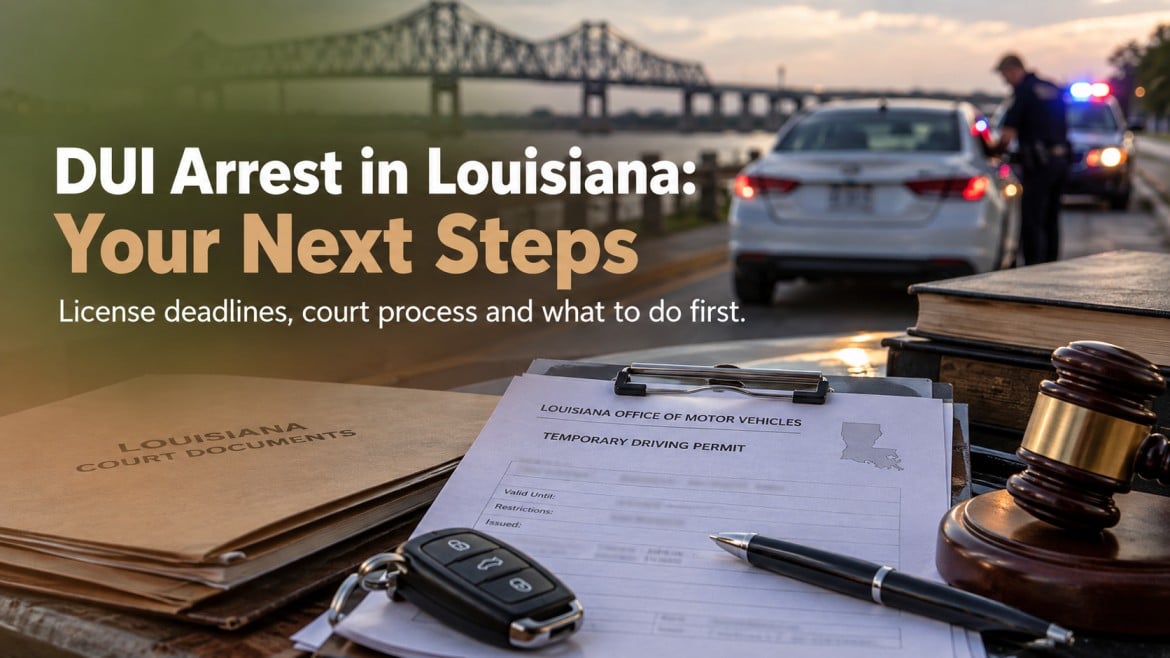
What Happens After a DUI Arrest? In Louisiana, two separate cases usually begin at the same time. One is an administrative case with the Office of Motor Vehicles (OMV) that decides your driver’s license. The other is a criminal court case that decides the charge. The license case moves first: you generally have 30 days from the date of arrest to request an administrative hearing in writing, and the temporary receipt the officer gives you allows driving for up to 30 days.
This guide explains the process in the order you’re likely to experience it, using Louisiana law as it stands in September 2026. It is general information, not advice about your case. Because Louisiana’s impaired-driving statutes changed in 2024, 2025, and 2026, the version of the law that applies can depend on the date of your arrest.
Key Takeaways
- The OMV deadline comes first. Miss the 30-day written request and the suspension takes effect automatically, with no hearing, even if the criminal case is still open.
- Winning one case does not resolve the other. The OMV decides your driving privileges under a lower standard of proof. The court decides guilt beyond a reasonable doubt.
- A refusal has its own penalties. A first refusal carries a one-year suspension, a second within ten years carries two years, and the refusal can be used as evidence against you in court.
- Most first and second offenders can keep driving. A restricted license is generally available once a functioning ignition interlock device is installed.
- Priors count for ten years, but not ten calendar years. Time awaiting trial, on probation or parole, or incarcerated is excluded from that calculation. A third offense is a felony.
DUI, DWI, or OWI: What Louisiana Calls the Offense
All three terms describe the same Louisiana crime. The offense is defined in La. R.S. 14:98, which the Legislature renamed in 2024 to “operating a vehicle while impaired.” Officers and courts still say DWI in everyday conversation, and older paperwork may say OWI or DUI. The label doesn’t change what the state must prove or what you face.
You Can Be Charged Even If You Were Under 0.08
A breath result below 0.08 does not end the case. Louisiana law allows a conviction in three ways: the driver was impaired by alcoholic beverages, the driver’s blood alcohol concentration was 0.08 percent or more, or the driver was impaired by another drug, a combination of drugs, or alcohol combined with drugs.
In practice, that means a driver at 0.06 who also shows signs of impairment can be charged, and so can a driver with no alcohol at all in a suspected drug case. A low reading is evidence the court weighs along with the video, the officer’s observations, and everything else. For drivers under 21, a 0.02 threshold applies for license purposes, and a separate underage offense exists.
What Happens Immediately After a DUI Arrest
In the first few hours, you will be booked, your license will usually be taken and replaced with a temporary receipt, and bail will be addressed. Release may not be immediate if the jail believes you are still impaired.
Booking and Processing
Booking normally includes fingerprints, photographs, a records check for prior offenses, and paperwork documenting the stop and any chemical test. If you took a breath test at the station or had blood drawn, the result or its pending status goes into the file.
Two documents from this stage matter most: the temporary receipt that replaces your license, and any paperwork showing the charge, bond, or court date. Keep both.
License Seizure and Your Temporary Driving Permit
When a driver is arrested for impaired driving and either refuses the chemical test or tests at 0.08 or above (0.02 or above if under 21), the officer must seize the license and issue a temporary receipt on a state-approved form. That receipt authorizes driving on Louisiana roads for up to 30 days from the date of arrest, and it serves as official notice of the deadline to request an administrative hearing.
If your blood was drawn and results are pending, the officer still issues the receipt. If the results have not been received within 30 days of the arrest, or an adult’s result comes back below 0.08, no hearing is held, and the license is returned without a reinstatement fee.
One practical detail people often miss: if the vehicle is operable and a sober, licensed passenger is present, the officer is required to let that passenger take control of the vehicle rather than calling a tow truck.
Bail and Conditions of Release
Most people arrested for a first-offense DWI are eligible for bail. The amount and conditions depend on the charge, prior record, and whether anyone was injured. Courts commonly add conditions such as no new arrests, no alcohol, ignition interlock use, or substance-use monitoring.
Treat these as court orders. A 2026 change to Louisiana’s interlock offense statute confirmed that interlock restrictions can arise from court-ordered release conditions, not just from probation. Driving without a required device can create a new charge separate from the DWI.
Louisiana’s Sober-Release Rule (Jada’s Law)
You may not be released the moment bond is posted. Under a 2026 law known as Jada’s Law, enacted as R.S. 14:98.9, the custodial agency may hold a person arrested for operating while impaired who is presumed to be under the influence of alcohol until a safe release is feasible. The law does not deny or restrict the right to bail, and it does not apply to anyone 17 or younger.
For families waiting at the jail, the delay may be this law rather than a problem with the bond. Because the statute is new, whether it applies at all depends on when the arrest occurred, and practices may vary between agencies.
What Happens After a DUI Arrest? The Two Separate Cases You Face
| Issue | The OMV Administrative Case | The Criminal Court Case |
| What it decides | Whether your driving privileges are suspended | Whether you are guilty of the criminal offense |
| Who runs it | The Louisiana Office of Motor Vehicles | The district attorney and the criminal court |
| What triggers it | The arrest itself, along with the test result or refusal | The charge filed by the prosecutor |
| Deadline to act | 30 days from arrest to request a hearing, or the suspension takes effect automatically | Court dates set by the court after charges are filed |
| If you do nothing | The suspension proceeds without any review | A warrant can issue, and the case moves forward without your input |
| Standard applied | An administrative standard, lower than the criminal standard | Guilt must be proven beyond a reasonable doubt |
| Possible outcome | Suspension upheld, reduced, or set aside | Dismissal, plea agreement, acquittal, or conviction |
| Effect of winning one | Does not by itself resolve the other case | Does not automatically restore your license |
The two tracks touch each other in limited ways. If you are later convicted, any license suspension from the conviction runs concurrently with the administrative suspension, so the total does not exceed the longer of the two. And if the charges end in dismissal, a permanent refusal to prosecute, or an acquittal, the law provides for reinstatement without a reinstatement fee.
The timing is what catches people out. The criminal case waits on the prosecutor’s charging decision, which can take weeks. The license clock starts the day of the arrest. By the time you first stand in front of a judge, the OMV window has often already closed, and the court cannot reopen it.
What You Should Do During the First Few Days
The most useful early steps are simple: protect your paperwork, calendar both deadlines, write down what you remember, and follow every condition of release.
- Gather and keep every document. The temporary receipt, the chemical-test rights form, bond paperwork, the citation, and any tow or impound records.
- Calendar two dates. Count 30 days forward from the arrest date for the OMV hearing request. Separately, note any court date on your paperwork.
- Write down your recollection now. The time and location of the stop, what the officer asked, where any field tests were performed, weather and road conditions, any injuries or medical conditions, and who was present. Memory fades fast, and this detail is hard to reconstruct later.
- Follow every release condition exactly. Attend each court date even if you expect a reset. A missed date can produce a warrant; a new violation can cost you your bond and weaken your position later.
- Do not assume the criminal case will sort out your license. The two are handled separately.
- Get case-specific advice before the 30-day mark. An attorney can file the hearing request, request the video and testing records, and advise whether an interlock-restricted license makes sense in your situation.
What Happens to Your Driver’s License
The 30-Day OMV Hearing Deadline
You have 30 days from the date of arrest to make a written request for an administrative hearing under La. R.S. 32:667. The deadline is the same whether you failed the test or refused it, and a phone call does not satisfy it. The Office of Motor Vehicles applies the same 30-day window from the date of arrest for refusal and test-result suspensions.
Filing on time also keeps you on the road. Once the department receives a timely request, it must issue a document extending the temporary license until the administrative proceedings are complete, and it must send the case to the Division of Administrative Law for a hearing within 60 days of receiving the request.
What the Administrative Hearing Decides
The hearing decides your license, not your guilt. It is held before an administrative law judge and is narrower than a trial. The scope generally covers whether the officer had reasonable grounds for the stop, whether the driver was informed of his rights, and whether the driver submitted to a test showing a result at or above the legal limit or refused testing.
The hearing has a second, practical value. It is often the first look at how the state’s paperwork, timeline, and video fit together, and inconsistencies found there can matter in the criminal case.
What Happens If You Miss the Deadline
The suspension takes effect automatically, with no review. There is one narrow exception: a person who could not request a hearing in time because of incarceration, hospitalization, or another cause the department accepts may submit documentation, but that late request must be made no later than 90 days from the arrest. Most people will not qualify, so the 30-day date should be treated as final.
How Long a Louisiana DWI Suspension Lasts
Suspension length depends on the test result, prior history, and age:
| Situation | Administrative suspension |
| Test at 0.08 or above, first offense | 180 days |
| Test at 0.08 or above, second or later violation within five years of the first | 365 days |
| Test at 0.15 or above, first offense | 2 years |
| Test at 0.15 or above, second offense | 4 years |
| Under 21, test at 0.02 or above | 180 days |
| First refusal | 1 year |
| Second or later refusal within ten years of a prior refusal | 2 years |
These periods are set by R.S. 32:667, which also provides that hardship eligibility is unavailable on a refusal suspension where a fatality or serious bodily injury occurred and the driver’s intoxication is found by a trier of fact to have contributed.
One wrinkle for first offenses: the OMV is directed to conform a first-offense suspension to the blood alcohol concentration reflected in the final case disposition and sentencing minutes, so the initial suspension can later be adjusted.
Restricted Licenses and Ignition Interlock
Many drivers can keep driving legally during a suspension. A driver suspended for a first or second offense who either refused testing or tested below 0.15 becomes immediately eligible for a restricted license on proof that a functioning ignition interlock device has been installed, and if the department refuses to issue it, the district court in the driver’s parish may order it. A driver who tested at 0.15 or above is eligible for a hardship license throughout the two-year or four-year suspension once an interlock is installed, and the device must remain on the vehicle for the entire suspension.
An ignition interlock is a breath-testing device wired to the ignition that prevents the car from starting if alcohol is detected. Installation, monitoring, and calibration costs fall on the driver.
Appealing an OMV Decision
If the administrative law judge upholds the suspension, you can ask a district court to review the decision. The OMV refers to this as a petition for judicial review, filed under the authority of R.S. 32:668. These petitions carry a short filing deadline that runs from the decision, so this is a step to raise with an attorney immediately rather than weeks later.
What Happens If You Refuse Chemical Testing
Refusing does not prevent a DWI charge. It guarantees a license suspension, can be used as evidence against you, and in some circumstances is a crime on its own.
How Louisiana’s Implied Consent Law Works
Under Louisiana’s implied consent law, beginning at R.S. 32:661, driving on the state’s public roads is treated as advance consent to chemical testing after a lawful impaired-driving arrest. Before testing, officers read a standard rights form.
There are situations where refusal is not an option at all. A person may not refuse testing if he has refused on two previous and separate occasions, or in any case where a fatality has occurred, or someone has sustained serious bodily injury in a crash.
Refusal Consequences at a Glance
The license suspensions for refusal appear in the table above. Louisiana State Police’s rights form states that driving privileges are suspended for one year on a first refusal and two years on a second or subsequent refusal within a ten-year period, that a refusal after two previous separate refusals is a crime under R.S. 14:98.7 carrying the same penalties as a first DWI conviction, and that evidence of the refusal will be used against you in court. That separate refusal offense carries a fine of $300 to $1,000 and imprisonment of ten days to six months.
A refusal also triggers an interlock requirement for reinstatement, discussed in the post-conviction section below.
How a Refusal Affects the Criminal Case
Prosecutors often argue that a driver refused because he expected to fail. The defense may point to other explanations, such as confusion about the warnings, a medical condition, or how the request was made. Without a test result, the state’s case usually relies more heavily on officer observations, driving behavior, field sobriety tests, and video, and in some circumstances officers may seek a warrant for a blood draw.
What Happens in the Criminal Case
Arraignment and the Pleas You Can Enter
The arraignment is normally your first court date, where the charge is formally addressed, and you enter a plea. Louisiana’s common pleas are guilty, not guilty, and no contest (nolo contendere), which requires the court’s consent. A not guilty plea preserves the defendant’s options while the evidence is reviewed.
A guilty plea at the first appearance is the hardest decision to undo. It creates a conviction that can be used to enhance a later offense and can affect the license outcome.
Conditions While the Case Is Pending
Courts often keep or add conditions: no new arrests, no alcohol, interlock use, substance-use screening, and attendance at every court setting. Keep proof of compliance, such as interlock reports or program attendance records. It can matter during negotiations and at sentencing.
The Evidence and What Can Be Challenged
A DWI case is assembled from several types of evidence, each with its own weak points.
| Type of Evidence | What the State Uses It For | Where It Can Be Challenged |
| Officer observations and the police report | Reasonable suspicion for the stop and probable cause for the arrest | Whether the stop was lawful, and whether the report matches the recorded footage |
| Field sobriety tests | Physical signs of impairment before any chemical test | Whether the tests followed standardized procedure, and whether conditions affected performance |
| Breath test results | Establishing blood alcohol concentration | Instrument calibration and maintenance, and operator certification |
| Blood test results | Establishing alcohol or drug concentration | Chain of custody, collection procedure, storage, and laboratory analysis |
| Urine test results | Detecting drugs in the system | Whether the result shows impairment at the time of driving rather than past use |
| Drug recognition evaluations | Supporting drug impairment without a BAC | Evaluator training, subjectivity, and alternative medical explanations |
| Dashcam and body-camera footage | Documenting driving behavior and the encounter | Whether the footage contradicts the written account, and whether any is missing |
The common thread is documentation. Louisiana law makes certain testing records, including instrument recertification forms, admissible as evidence, which means much of the state’s proof arrives on paper. Comparing that paperwork with the video can reveal inconsistencies or procedural issues that may affect how the case is evaluated.
Pretrial Motions
Before trial, the defense can ask the court to rule on legal issues. The most significant is a motion to suppress, which argues that evidence was obtained unlawfully, usually focusing on whether there was reasonable suspicion for the stop, probable cause for the arrest, or compliance with testing procedures. Other motions seek discovery of video, calibration records, and lab files. If key evidence is suppressed, the case can change shape entirely.
Plea Negotiations, Article 894, and Diversion
Most DWI cases resolve without a trial. Possible outcomes include a plea to a reduced charge, a plea handled under Code of Criminal Procedure Article 894, which allows certain misdemeanor convictions to be set aside and the prosecution dismissed after probation, or a pretrial diversion program where the district attorney offers one.
Two limits are important. Article 894 dismissal has the effect of an acquittal, except that the conviction may still be considered a prior offense for a later prosecution, and for operating a vehicle while intoxicated this relief is available only once in a ten-year period, with a narrow exception for a defendant who completes a certified DWI or sobriety court program. Eligibility for any of these outcomes depends on prior history, BAC, whether a crash or child passenger was involved, and local prosecutor policy.
Taking a DWI Case to Trial
At trial, the state must prove each element beyond a reasonable doubt, and the defense can cross-examine the officer, challenge test results, and present its own evidence. A misdemeanor DWI is tried before a judge rather than a jury. A standard first- or second-offense misdemeanor DWI is tried by the court without a jury under Louisiana’s current misdemeanor-trial rules. A felony DWI, such as a third offense, is handled differently and may carry a jury-trial right.
Where Lafayette-Area Cases Are Heard
Where your case proceeds depends on where the arrest happened and what is charged. Misdemeanor DWI arrests within Lafayette city limits are commonly prosecuted in Lafayette City Court, while arrests elsewhere in the parish and all felony DWI charges are handled in the 15th Judicial District Court, which serves Lafayette, Acadia, and Vermilion parishes. Other Acadiana parishes and municipalities have their own courts. Louisiana law permits city, parish, and municipal courts to prosecute impaired-driving cases under the state statute or an equivalent local ordinance, so the same conduct can be handled in different courtrooms with different schedules and practices. Check the court named on your paperwork.
How Long a Louisiana DWI Case Takes
There is no fixed timeline. A straightforward misdemeanor may resolve in a few months, while cases involving blood or drug testing, suppression motions, injuries, or felony charges often take considerably longer, largely because lab results and discovery take time. Louisiana’s Code of Criminal Procedure sets outer limits, generally requiring trial to begin within one year of the institution of prosecution for a misdemeanor and two years for most felonies, subject to interruptions and suspensions. Resets are common in busy courts.
Louisiana DWI Penalties
Penalties are set by statute but vary widely within those ranges. Several factors drive the outcome:
| Factor | How It Affects the Outcome |
| Number of prior offenses | Penalties increase with each offense, and a third offense becomes a felony |
| Blood alcohol concentration | Higher readings trigger mandatory jail time and longer license suspensions |
| Whether a crash or injury occurred | Can elevate the charge well beyond a standard DWI |
| Time between offenses | Priors count only if they fall within the statutory lookback period |
| Child passenger | A minor 12 or younger in the vehicle blocks suspension of the mandatory minimum |
| Treatment participation and compliance | Can influence sentencing, probation terms, and program eligibility |
The lookback deserves special attention because it is not ten calendar years. A prior conviction generally does not count if it was committed more than ten years before the current offense, but periods during which the offender was awaiting trial, under an order of attachment for failure to appear, on probation or parole, or incarcerated are excluded from that ten-year calculation.
The figures below are statutory ranges, not predictions.
First Offense
A first conviction under R.S. 14:98.1 carries a fine of $300 to $1,000 and imprisonment of ten days to six months. The sentence may be suspended only if the offender is placed on probation with minimum conditions: 48 hours in jail that cannot be suspended, or at least 32 hours of court-approved community service; a court-approved substance abuse program including a substance use disorder screening; a driver improvement program; and an order not to drive without a functioning ignition interlock for at least six months of probation.
Higher readings add mandatory time. At 0.15 to under 0.20, at least 48 hours must be served without benefit of parole, probation, or suspension. At 0.20 or above, the fine rises to $750 to $1,000 with the same 48-hour requirement. A first-offense BAC of 0.15 or more also brings a two-year license suspension.
In many first-offense cases, courts impose probation with these conditions rather than a long jail term. That is not guaranteed, and aggravating facts change the picture.
Second Offense
A second conviction under R.S. 14:98.2 carries a fine of $750 to $1,000 and imprisonment of 30 days to six months, with at least 48 hours served without benefit of parole, probation, or suspension. Probation requires at least 15 days in jail, or 240 hours of community service, plus a court-approved substance abuse program. A second-offense BAC of 0.15 or more brings a four-year license suspension, and a reading of 0.20 or more adds a $1,000 fine with at least 96 hours served without benefit.
Third Offense: A Felony
A third conviction under R.S. 14:98.3 carries a $2,000 fine and one to five years of imprisonment, with or without hard labor, with at least one year served without benefit of parole, probation, or suspension — though that mandatory year may be suspended if the offender is accepted into a drug division probation program. On a third or subsequent conviction, the court must order the vehicle seized and sold at auction if the district attorney files a motion to forfeit it.
A felony conviction reaches beyond the sentence, affecting firearm rights, employment, and housing applications.
Fourth and Subsequent Offenses
A fourth or subsequent conviction under R.S. 14:98.4 carries a $5,000 fine and ten to thirty years of imprisonment, with two years imposed without benefit of parole, probation, or suspension. Exposure increases further for offenders with certain prior sentences, and a prior conviction for vehicular homicide, third-degree feticide, or first-degree vehicular negligent injuring raises the range to twelve to thirty years without benefit. A 2026 act increased enhanced-penalty exposure in several repeat-offender situations involving those serious prior convictions, so the date of the current offense matters.
Special Situations
Drug-Impaired Driving
A prescription is not a defense if the medication actually impaired your driving. Louisiana’s statute defines “drug” as any substance or combination of substances that can impair a person’s ability to operate a vehicle safely, which covers illegal substances, prescribed medications, over-the-counter drugs, and combinations with alcohol.
Drug cases are proven differently. There is no general per se limit for most drugs, and many substances remain detectable long after their effects end, so the state often relies on observations, a drug recognition evaluation, and blood or urine results. The license side can also differ, because the administrative seizure statute is triggered by a refusal or by a qualifying BAC result. Whether an administrative suspension applies in a drug-only case is worth confirming rather than assuming.
Crashes, Injuries, and Fatalities
An injury crash changes your exposure across the board. Depending on the harm, charges may include vehicular negligent injuring under R.S. 14:39.1 or, where there is serious bodily injury, first degree vehicular negligent injuring under R.S. 14:39.2, a felony. Where someone dies, vehicular homicide under R.S. 14:32.1 applies. As noted above, a crash involving a fatality or serious bodily injury also removes the right to refuse testing and can eliminate hardship-license eligibility on a refusal suspension.
An arrest involving a crash with moderate or serious bodily injury also triggers an ignition interlock requirement as a condition of license reinstatement. A civil claim from the injured person may proceed alongside the criminal case, and statements made at the scene or to an insurer can surface in both.
Child Passenger Cases
Under Louisiana’s Child Endangerment Law, if the state proves a minor 12 years of age or younger was a passenger at the time of the offense, the execution of the mandatory minimum sentence cannot be suspended. That circumstance also requires an ignition interlock as a condition of reinstatement.
Commercial Driver’s License Consequences
CDL holders face a separate, stricter set of rules. Under federal regulations applied in Louisiana (49 C.F.R. § 383.51), a first impaired-driving conviction or chemical test refusal generally disqualifies a CDL holder from operating a commercial vehicle for one year, or three years when transporting hazardous materials, even when the arrest occurred in a personal vehicle. A second qualifying offense can result in lifetime disqualification, and the alcohol limit while operating a commercial vehicle is 0.04. Federal rules also restrict masking convictions through diversion, so options available to other drivers may not help a CDL holder.
Employment, Insurance, and Professional Licensing
A DWI can affect jobs that require driving or a clean background check, and a conviction commonly raises insurance premiums or leads to non-renewal. Licensed professionals, including nurses, teachers, and others, may have board reporting obligations after an arrest or conviction, sometimes on their own deadlines. Checking your board’s reporting rules early prevents a second problem from developing while the first is still pending.
What Happens After a DWI Conviction
Completing Court-Ordered Requirements
A conviction brings fines and court costs, jail time or community service, substance abuse screening or treatment, a driver improvement program, and probation. Keep receipts and completion certificates. If an offender on probation fails to complete required substance abuse treatment or a driver improvement program, or violates another condition, probation may be revoked and the balance of the suspended sentence imposed.
Reinstatement and Post-Conviction Interlock
Reinstatement is not automatic when the suspension period ends. R.S. 32:667 requires a $50 reinstatement fee after an administrative suspension, and an ignition interlock is required as a condition of reinstatement for anyone who refused testing, who tested at 0.08 or above on an arrest occurring within ten years of a prior arrest, who was involved as a driver in a crash with moderate or serious bodily injury, or who had a child 12 or younger in the vehicle.
The device must stay installed for at least six months, and for the same period as the suspension, with credit for time it was installed under a restricted license. Removing or disabling a required device early results in suspension until it is properly reinstalled. Other fees and proof requirements can apply.
How a DWI Appears on Your Driving Record
Your OMV driving record is separate from your criminal record, and it is what insurers, employers who check driving history, and future courts typically see. Convictions and administrative suspensions are reported to the OMV and remain part of that record even where criminal relief is later obtained.
Whether a Louisiana DWI Can Be Expunged
Often, yes, subject to waiting periods. A misdemeanor DWI conviction may generally be expunged after it is set aside and dismissed under Article 894, or once five years have passed since completion of the sentence with no felony conviction during that period. A DWI resolved through pretrial diversion generally cannot be expunged until five years after the arrest.
Expungement makes a record confidential rather than destroying it. A petition to expunge a DWI conviction must include a certified letter from the Office of Motor Vehicles, and an additional $50 fee applies; the expunged record remains available to persons and entities listed in the Code of Criminal Procedure. That is one reason an expunged or set-aside DWI can still be used as a prior offense. Sorkow Law’s expungement page covers the process in more detail.
Frequently Asked Questions
How long do I have to request an OMV hearing after a DUI arrest?
Thirty days from the date of arrest, and the request must be in writing. A phone call does not count. A late request is allowed up to 90 days only if you can document that incarceration, hospitalization, or another accepted cause prevented a timely request. If no request is made, the suspension takes effect automatically without review.
Can I drive after a DUI arrest in Louisiana?
Usually, for a limited period. The temporary receipt the officer issues allows driving in Louisiana for up to 30 days from the arrest. If you request the hearing on time, the department extends that temporary license until the administrative case is decided. After a suspension begins, many drivers qualify for a restricted license with an ignition interlock.
What happens if I refuse the breath test?
A first refusal carries a one-year suspension; a second within ten years of a prior refusal carries two years. The refusal can be used as evidence in the criminal case, and an interlock is required for reinstatement. Refusing does not prevent a DWI charge, and refusing after two prior refusals is itself a crime.
Is a first-offense DWI a misdemeanor in Louisiana?
Yes. A standard first offense is a misdemeanor tried before a judge, carrying a $300 to $1,000 fine and ten days to six months in jail, which may be suspended with probation conditions including 48 hours in jail or 32 hours of community service. A BAC of 0.15 or higher, a child passenger, or an injury crash changes that analysis.
Can a DWI charge be dismissed or reduced?
It happens, but nothing is guaranteed. Outcomes depend on the lawfulness of the stop, the reliability of the testing, the video, prior history, and local prosecutor policy. Options can include dismissal after a successful suppression motion, a reduced charge, diversion, or an Article 894 disposition that sets the conviction aside after probation.
Will a DWI affect my commercial driver’s license?
Very likely. Federal rules generally disqualify a CDL holder from commercial driving for one year after a first impaired-driving conviction or test refusal, even if the arrest occurred in a personal vehicle, and for three years with a hazmat endorsement. A second qualifying offense can bring lifetime disqualification.
Can a DWI be expunged from my Louisiana record?
Often, once eligibility requirements are met, such as an Article 894 set-aside or a five-year wait after completing the sentence. Expungement makes the record confidential rather than erasing it. Courts, prosecutors, and certain agencies can still access it, and the offense can still count as a prior for sentencing purposes.
Talk to a Lafayette DWI Attorney Before the OMV Deadline Passes
The decisions that are hardest to undo come early: letting the 30-day license deadline pass, and resolving the criminal charge before the video, testing records, and paperwork have been reviewed. Both deadlines run on their own schedule, and the court cannot fix a missed OMV date.
Sorkow Law, LLC is a Lafayette firm founded by attorney Benjamin Sorkow, handling DUI/OWI defense as part of its criminal defense practice for clients in Lafayette and across Louisiana. The firm can file the administrative hearing request, request discovery in your case, review how the stop, testing, and arrest were handled, and explain the realistic options on both the license and criminal sides.
Call 337-761-5329 or request a free, confidential consultation. The office is at 5040 Ambassador Caffery Pkwy., Lafayette, Louisiana 70508.